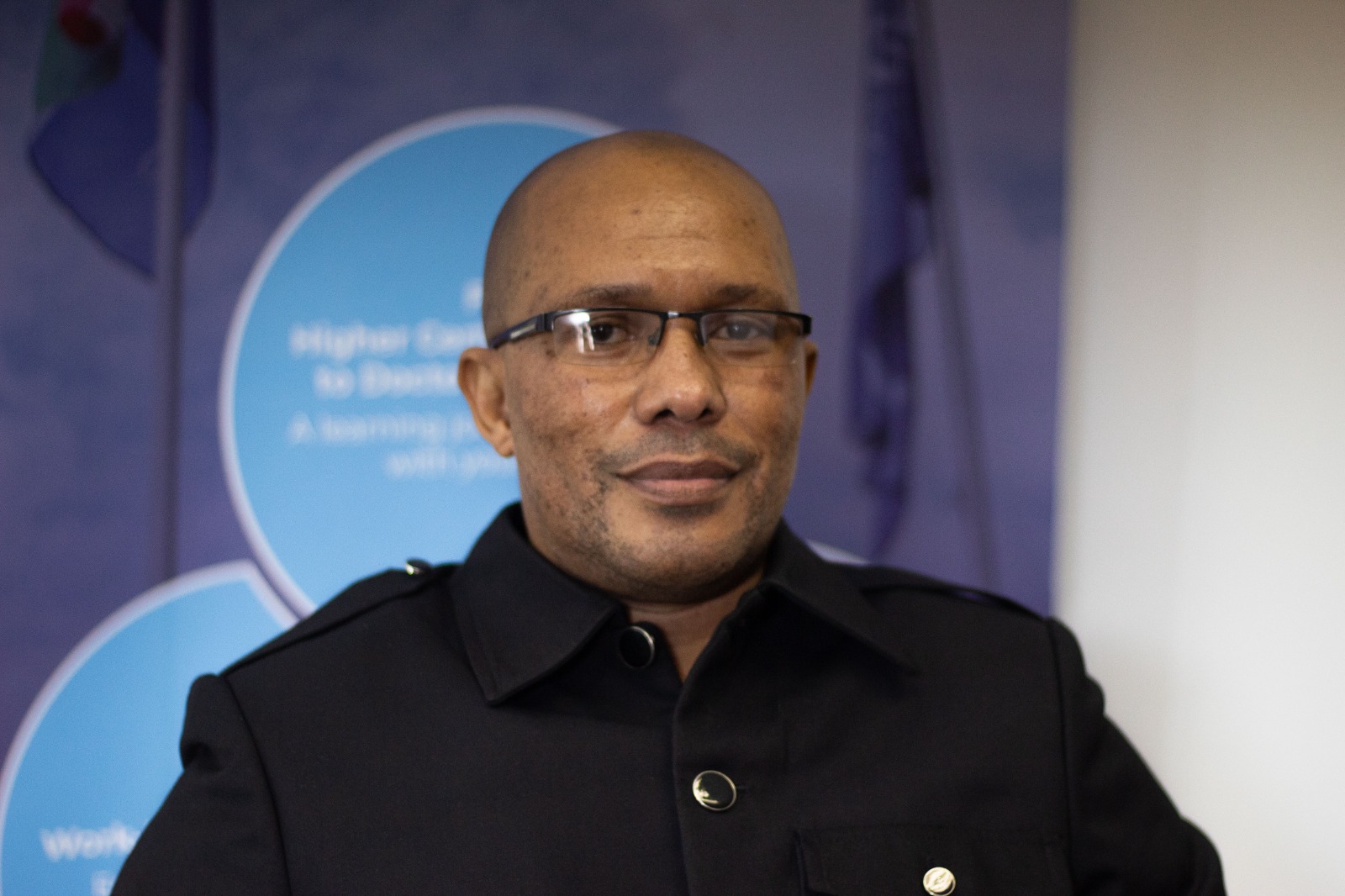
In a world that is increasingly undefinable, Dr Morne Mostert embodies the reimagining of education’s purpose and practice. A long-time advocate for thinking as the highest form of human capability, he stands at the forefront of this transformation. In an interview with The DaVinci Institute doctoral alumnus, Dr Mostert explores the evolving purpose of education, the nature of applied learning, and the profound implications of artificial intelligence (AI) on human consciousness, creativity, and capability.
His reflections invite us to think beyond compliance-driven education and to cultivate learning systems that enable students not merely to know, but to think, imagine, and design for a shared future. Dr Mostert’s doctorate focused on an integrated approach to leadership development through systemic leadership learning.
The Future of Learning and the DaVinci Philosophy
Asked about DaVinci’s contribution to contemporary education, Dr Morne Mostert began by situating the institute within a broader global shift.
“The DaVinci Institute is not just another institution of higher learning. It represents a significant thinking movement, a deliberate effort to redefine learning as the process of expanding capability rather than accumulating information,” he said.
He shared that DaVinci’s focus on applied learning challenges the industrial-era assumption that theory precedes practice. At DaVinci, it is the reverse hierarchy. Practice is not a lower form of knowledge; it is simultaneously knowledge in action and generative of new knowledge
Dr Mostert argued that such an approach is essential in an age where the half-life of knowledge continues to shrink exponentially. Knowledge now expires faster than institutions can validate it. That means that education can no longer be thought of as transmission; it must be conceived of as transformation.
Thinking as a Capability

Throughout the conversation, Dr Mostert returned to the theme of thinking not as a generic skill but as a disciplined capability.
“When I speak about thinking, I do not mean merely cognition or logic. Thinking, particularly for senior executives, is the ability to make meaning in context, to integrate, to discern, to connect, and to imagine alternatives,” he shared.
He suggested that higher education often mistakes compliance for capability. Many institutions have become agents of obedience rather than agents of curiosity. Students learn to satisfy institutional criteria, but not necessarily to deploy thinking. That is why DaVinci’s emphasis on critical, creative, and systems thinking is so important. It restores learning as a deep human act of exploration.
According to Dr Mostert, the future belongs not to those who know the most, but to those who think best in ambiguity. In complex systems, prediction is impossible. What matters is the ability to sense, interpret, intuit and respond; to navigate meaningfully when certainty is no longer available. That is the advantage of thinking.
Artificial Intelligence and the Meaning of Human Learning
Turning to the rise of AI, Dr Mostert described it as both an opportunity and a profound philosophical challenge.
“Artificial intelligence already outperforms humans on many cognitive tasks. The question, therefore, is not whether we can compete, but whether we can collaborate and, more importantly, whether we can rediscover what is distinctly human,” said Dr Mostert.
As technology becomes pervasive, it is stirring the uncomfortable realistion that we may not know much about the nature, art and science of being human.
He noted that while AI excels at processing data, it cannot yet engage in contextual meaning-making. AI can simulate language, but it cannot experience. It can predict, but it cannot imagine with meaning. It can connect information, but it cannot connect emotion. That distinction between computation and consciousness is one of the new frontiers of education.
For Dr Mostert, this has radical implications for curriculum design. If machines can already do what institutions train students to do, then education must investigate what machines cannot: reflection, ethics, judgment, creativity, and the capacity to design alternative, more preferable futures.
On Systems Thinking and the Fifth Industrial Revolution
Dr Mostert emphasised that education must now be understood within a systems context.
“We are entering what some call the Fifth Industrial Revolution, an era that integrates technology with humanity. But this integration will succeed only if we think systemically, understanding that every action, every innovation, exists within a web of increasingly invisible relationships,” he said.
He elaborated that systems thinking is not about drawing circles and arrows. It is about perceiving wholeness, seeing how elements interact dynamically to produce emergent realities. It is the discipline of intellectual humility.
When asked how DaVinci embodies this approach, Dr Mostert highlighted its integrated model of Management, Leadership, and Innovation. He said DaVinci does not teach these as separate disciplines. It stimulates emerging insights through interdependent modes of thinking, managing complexity, leading meaningfully, and innovating responsibly.”
He added that this orientation prepares students for the ethics of the new economy.
“We cannot talk about innovation without discussing consequences. Systems thinking compels accountability, the recognition that every design has circular ripple effects. That is what distinguishes a technologist from a responsible innovator,” he said.
Purpose, Curiosity, and the Co-Creation of Knowledge
At the heart of Dr Mostert’s philosophy is the belief that education should be a co-creative process.
“Institutions do not own knowledge, but knowledge is co-created in dialogue, between learner and facilitator, between theory and practice, between self and society,” he explained.
He noted that DaVinci’s learning model encourages curiosità, a Leonardo-inspired concept of disciplined curiosity. When asked how learners can cultivate this balance, Dr Mostert emphasised the importance of bold curiosity and humble self-direction. He added that to direct yourself is to take responsibility for your learning journey, to interrogate assumptions, to frame your own challenges, and to pursue meaning rather than mere achievement.
The Role of the Educator in a Changing World
On the evolving role of educators, Dr Mostert was clear that in the new paradigm, the educator is not a transmitter of knowledge but a designer of learning experiences. The task is to create conditions where higher-order thinking can occur.
“This means educators must themselves become thinkers able to model curiosity, critical reflection, and ethical judgment. You cannot teach thinking if you are afraid of ambiguity. The educator’s power now lies not in having the answers but in framing stimulating questions,” he said.
Dr Mostert also warned against the commodification of education; adding that when learning becomes a product, curiosity dies. True education is not transactional; it is transformational. It is about awakening capability, the capacity to generate new possibilities in a rapidly changing world.
Reimagining the Future of Education
Asked to imagine the future of higher education, Dr Mostert responded thoughtfully. The future will not be defined by buildings, timetables, or credentials. It will be defined by networks of thinking, communities of practice united by curiosity and purpose.
He envisaged learning environments where technology supports contextual intelligence rather than replaces it.
“AI will not be the teacher; it will be the mirror, reflecting our thinking to us. It will challenge us to ask better questions,” he said.
Finally, he believes that the future of education depends on our ability to re-humanise learning. The next revolution is not digital; it is existential. He added that we must decide what kind of species we want to be in a world of intelligent machines. Education is the instrument through which that decision is made.
Closing Reflection: Dr Morne Mostert
Dr Morne Mostert’s reflections remind us that the true frontier of education lies not in technology, but in thought. As The DaVinci Institute continues to nurture thinkers, innovators, and leaders capable of navigating complexity with wisdom and care, its challenge is both timely and profound: to reclaim education as the art of thinking, the discipline of meaning-making, and the moral practice of designing a humane future.
Leave a Reply