
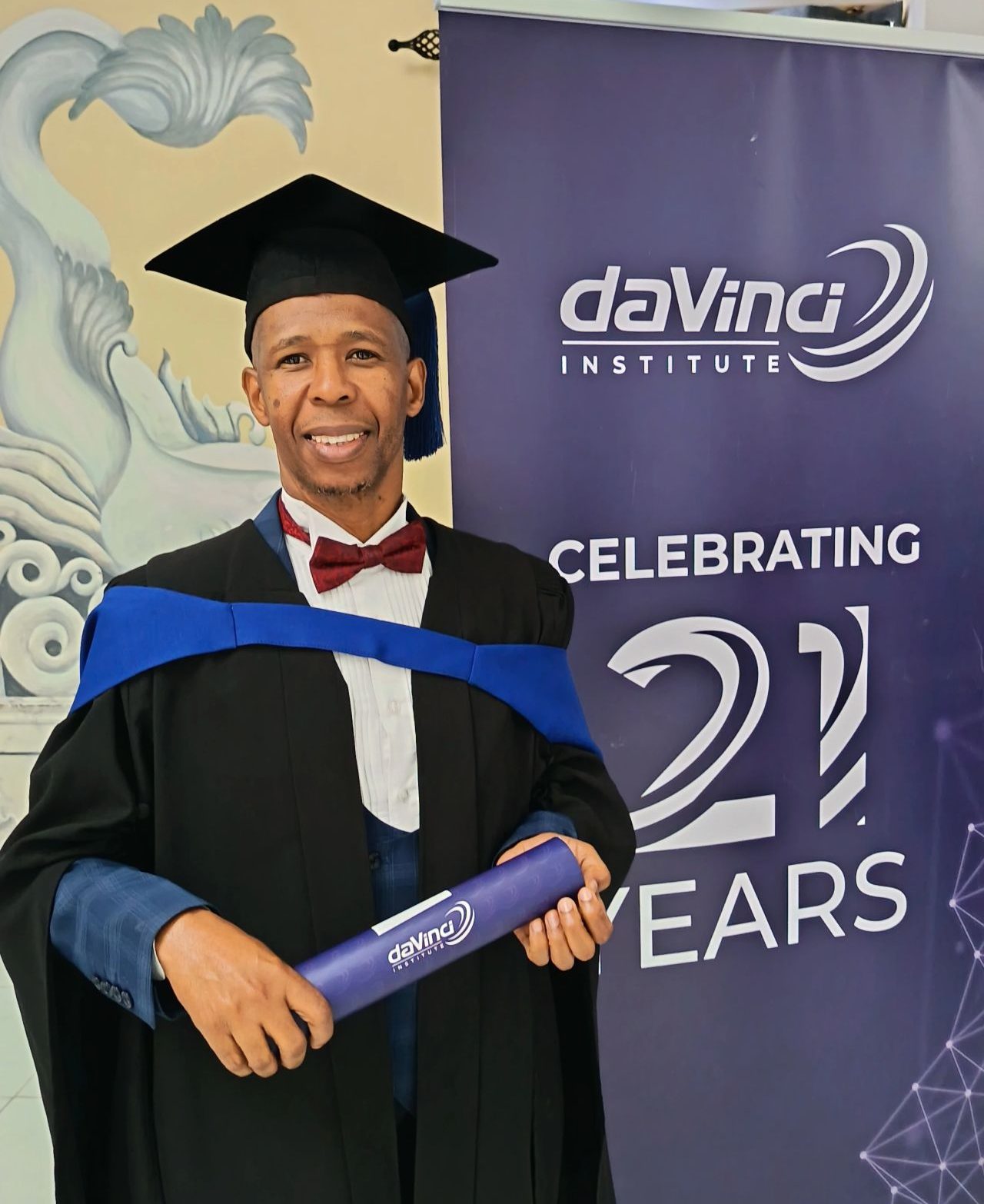
Pursuing a doctoral degree is often described as one of the most demanding academic journeys a professional can undertake. For one ICT Operations Manager, the experience at The DaVinci Institute proved to be more than an academic qualification; it became a transformative journey of personal growth, professional development, and organisational impact. The story of Dr Victor Nhlanhla Nyathikazi.
Commitment and Perseverance
Reflecting on his doctoral studies, he describes the experience as challenging but deeply rewarding.
“My doctoral journey was not always smooth, but I would not necessarily describe it as rough. It required dedication, commitment, and preparation from the very beginning,” stated Dr Nyathikazi.
A significant contributor to his preparedness was The DaVinci Institute’s emphasis on personal development through psychometric assessments. These assessments, provided valuable insights that helped him understand himself better and navigate the demands of doctoral research.
“The psychometric assessments were particularly helpful in preparing me for the journey. They helped me better understand myself and prepare for the challenges ahead,” he reflected.
A Supportive Academic Environment
One of the defining characteristics of his experience was the institution’s commitment to student support and professionalism.
“When I reflect on The DaVinci Institute as a whole, I can confidently say that my experience was exceptional. I would rate the institution 100%. I enjoyed the journey,” stated Dr Nyathikazi.
The responsiveness of the academic and administrative teams left an impression.
“Whenever I sent an email, it was acknowledged promptly and dealt with efficiently. The responsiveness and support provided throughout the programme were outstanding,” he alluded to the support.
He also credits much of his success to the guidance and encouragement provided by the doctoral leadership team, particularly the programme convener.
“I would like to commend Dr Raymond for the excellent work he does. He was highly professional, consistently encouraging, and always motivated us to keep moving forward, regardless of the challenges we faced,” he said.
The colloquium workshops played a particularly important role in his academic development. These sessions provided practical guidance during critical stages of the research process, including methodology development and the presentation of findings.
The workshops equipped students with the necessary skills and confidence to progress successfully through their studies. Without that level of institutional support, the journey would have been significantly more difficult.
Transforming Professional Practice
While the doctoral programme contributed to his academic growth, its greatest impact was perhaps realised in the workplace.
Since beginning his studies, he has experienced substantial professional development, particularly in leadership, communication, and strategic thinking.
“My presentation skills have improved considerably, and I have become more confident in communicating ideas and presenting myself professionally,” said Dr Nyathikazi.
The timing of his doctoral studies coincided with a major strategic initiative within his organisation. As part of a team responsible for developing a five-year ICT Strategy, he found himself applying insights gained from his studies directly to organisational challenges.
“The knowledge, insights, and skills gained through the doctoral programme enabled me to contribute meaningfully to the development and implementation of this strategy,” he said.
His experience demonstrates how doctoral research can extend beyond academia to create tangible organisational value and strategic impact.
Leading in a Complex ICT Environment
As an ICT Operations Manager, he operates within a highly dynamic and complex environment where technology, governance, and service delivery intersect.
His responsibilities span several critical functions, including cybersecurity management, server administration, service management, and policy development. In addition to overseeing technical operations, he plays an important governance role by ensuring compliance with organisational standards and contractual obligations.
He manages multiple teams and service areas, including service management, technical support, server engineering, and cybersecurity services delivered through external providers.
“Although cybersecurity services are outsourced, we remain accountable for ensuring that all deliverables are achieved and that service providers meet their contractual obligations.”
This combination of operational leadership and strategic oversight provided a rich context for doctoral research focused on organisational transformation and digital innovation.
Applying the DaVinci TIPS™ Framework
A central component of his doctoral research was the development of a framework designed to address organisational challenges associated with traditional, manual processes.
His organisation was seeking to modernise operations and embrace digital transformation. The DaVinci TIPS™ Framework became an important tool in guiding this work.
“My study focused on developing a framework to address organisational challenges that we were experiencing in the workplace. At the time, many of our processes were still manual and based on traditional approaches,” he said.
The framework’s four pillars aligned closely with his research objectives and provided both conceptual and practical guidance for understanding digital transformation.
“The TIPS™ Framework added significant value to my research. Its pillars aligned closely with the objectives of digital transformation and process modernisation that formed the foundation of my study,” said Dr Nyathikazi.
Through this approach, he was able to develop a practical framework capable of supporting organisational digitalisation, improving operational efficiency, and strengthening overall organisational performance.
A Testament to Lifelong Learning
His doctoral journey shows the powerful connection between academic research and professional practice. More than a qualification, the experience strengthened his leadership capability, enhanced his strategic thinking, and enabled him to contribute more effectively to organisational transformation.
For professionals considering a doctoral journey, his experience offers a compelling example of how perseverance, institutional support, and a commitment to lifelong learning can create lasting impact, not only for the individual but also for the organisations and communities they serve.
Leave a Reply