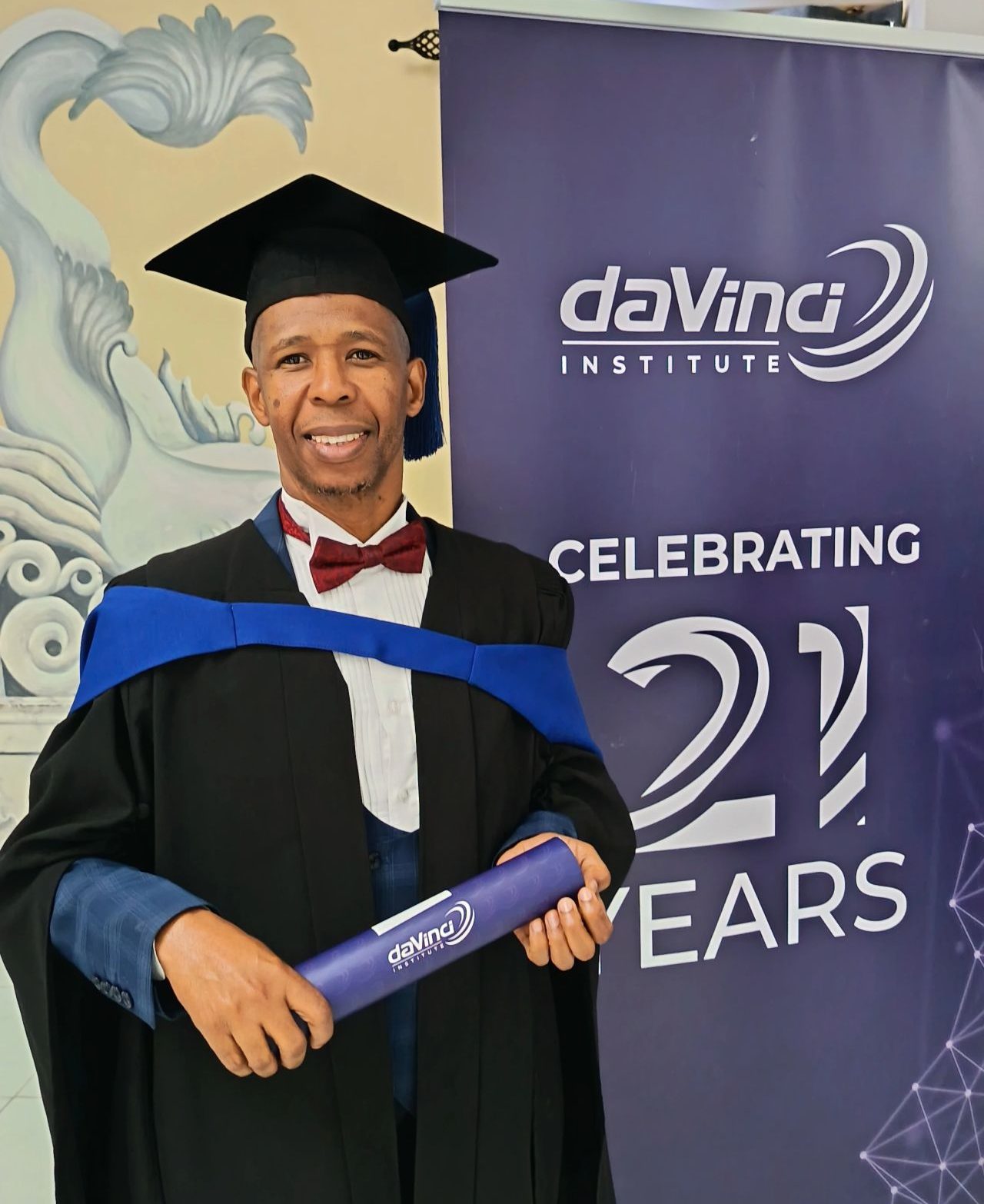
The DaVinci Institute Alumnus and new Convocation Executive Member, Bram Meyerson’s professional career began in the late 1980s, when information technology was rapidly evolving. After studying Computer Science and Applied Mathematics at the University of the Witwatersrand, he began his career in 1987 at a consulting firm that operated at the interface between business and technology.
Unlike traditional firms, the consultancy focused on IT strategy and systems design, helping organisations translate strategic intent into effective technology solutions. By 1992, Meyerson had gained enough confidence to start his own company, Quantimetrics, which brought a unique methodology to South Africa, quantitative measurement for software development projects, similar to quantity surveying in construction.
Through this approach, he was able to measure software project size and complexity, benchmark software-delivery efficiency across companies, and help clients estimate costs and performance outcomes. Over time, his work expanded to include operational benchmarking across banks, asset managers, and insurance companies, enabling organisations to compare performance anonymously and identify efficiency gaps.
Measurement and Systems Thinking
Meyerson’s interest in benchmarking evolved into a deeper curiosity about systems thinking, the understanding of cause-and-effect relationships within organisations. This curiosity led him to pursue a master’s degree at The DaVinci Institute, where his dissertation focused on “The Role and Relevance of Benchmarking in Information-Intensive Organisations.”
“The key takeaway from my time at DaVinci was learning to think systemically. After completing a benchmarking study, I could facilitate a workshop and use systems thinking to show clients how different levers influence outcomes of operational strategies, what causes these outcomes, and where to intervene,” he recalls.
This systems-based approach now underpins much of his work in IT management, cost evaluation, forensic analysis, and risk management, all disciplines that rely on quantifiable data and systemic insight. Meyerson’s mantra now is to help his clients ensure that they get “value” from their technology investments.
Governance, Risk, and Automation

Over the years, Meyerson’s professional interests have expanded to include corporate governance and risk management. He is a member of the Institute of Directors South Africa (IoDSA). His governance expertise includes serving as the independent Chairperson of the ITC Steering Committee within a government entity that forms part of the DTIC Group, the Department of Trade, Industry, and Competition.
More recently, he has ventured into automation, leading a Pan-African distributorship for an Australian software company that automates complex finance processes. Unlike traditional Robotic Process Automation (RPA), which replaces low-skill manual tasks, this platform automates high-value processes managed by skilled professionals, reducing turnaround times from days to minutes while retaining human oversight.
However, Meyerson is quick to emphasise a balanced approach to technology adoption.
“We must be careful not to use technology to replace people. Automation should free people from repetitive work so they can focus on analysis, decision-making, and value creation,” he cautions.
Technology and the Informal Economy
Reflecting on South Africa’s socio-economic challenges, Meyerson acknowledges the limitations of current manual systems and the need for technology-driven insights. Yet, he warns against viewing automation solely as a tool for efficiency.
“The challenge is not whether the technology exists, but how we use it responsibly. The solution lies in designing what he describes as “the capable enterprise”, which includes repurposing people into new roles.
For Meyerson, ethical technology management, a theme aligned with the new King V governance principles, must go hand-in-hand with people development. Without clear communication and proper change management, he warns, employees can feel threatened and even resist digital transformation.
Balancing Industrialisation and the Creative Economy
When asked about the tension between industrialisation and the creative economy, Meyerson points to the importance of attitude and education. He contrasts the digital appetite, based on his experience in automation adoption in Kenya, which he believes has an emerging innovation-driven mobile-first attitude. In South Africa, the supply of digital skills from formal education is not keeping pace with demand.
“Governments need to provide educational pathways that match the skills required by the economy,” he alludes.
Reimagining DaVinci’s Role and the Future of Learning
As a newly appointed member of The DaVinci Institute’s Convocation Executive Committee, Meyerson is eager to contribute to strengthening the bridge between academia and industry. He praises the applied learning philosophy of DaVinci but believes the institute can go further in aligning student research with real-world industry challenges.
He also sees opportunities to refresh the research methodology component, making it more engaging and practically oriented, and to embed governance and sustainability themes more deeply into the TIPS™ Framework.
From Mode 1 to Mode 2 and Beyond
Having studied in a Mode 1 (traditional) environment before experiencing Mode 2 (applied, transdisciplinary) learning at DaVinci, Meyerson appreciates the stark contrast and the need for both.He believes that schools and universities should promote STEM, Science, Technology, Engineering, and Mathematics curriculum and that students should also have broader exposure to disciplines like psychology, economics, and politics, subjects that help students understand how the “world works,” he reflects. Many of South Africa’s skill challenges result from an overreliance on Mode 1 education, which prioritises theory over application. He advocates for a broader, more holistic approach to learning, one that equips graduates to think critically, adapt to change, and navigate complex systems.
Closing Remarks
Bram Meyerson’s journey has pivoted from the foundations of technology management to a future defined by systems thinking, ethical leadership, and responsible innovation. Bram views technology as a transformative enabler that empowers people, unlocks human potential, and propels organisations toward purposeful, sustainable growth

Leave a Reply