
In South Africa, conversations about transformation often begin with policy. Strategies are drafted, frameworks are approved, and ambitions are clearly articulated. Yet, as many citizens experience daily, the gap between intention and execution remains wide, especially at the level where it matters most, local government.
This gap is not new. What is changing is how it is being understood and addressed. Increasingly, it is being approached not only as a policy or technical challenge, but as a systems and leadership question. This shift sits at the heart of the Doctor of Business Leadership offered by The DaVinci Institute, where the focus extends beyond academic achievement toward real-world impact.
For Tshegofatso Gama, a DBL candidate and business development professional in the higher education sector, this is not an abstract idea. It is the foundation of her work.
Her journey into doctoral studies began at a deeply personal moment. Fresh from maternity leave, with a three-month-old baby, she decided many would consider it unconventional.
“I wanted a better life for myself and for my child. I knew this was the time. It was a challenge, but I am someone who rises to challenges,” she explains.
That decision has evolved into a research journey that reflects the DaVinci philosophy of linking learning to impact, and personal ambition to societal contribution.
From Academic Study to Systemic Impact
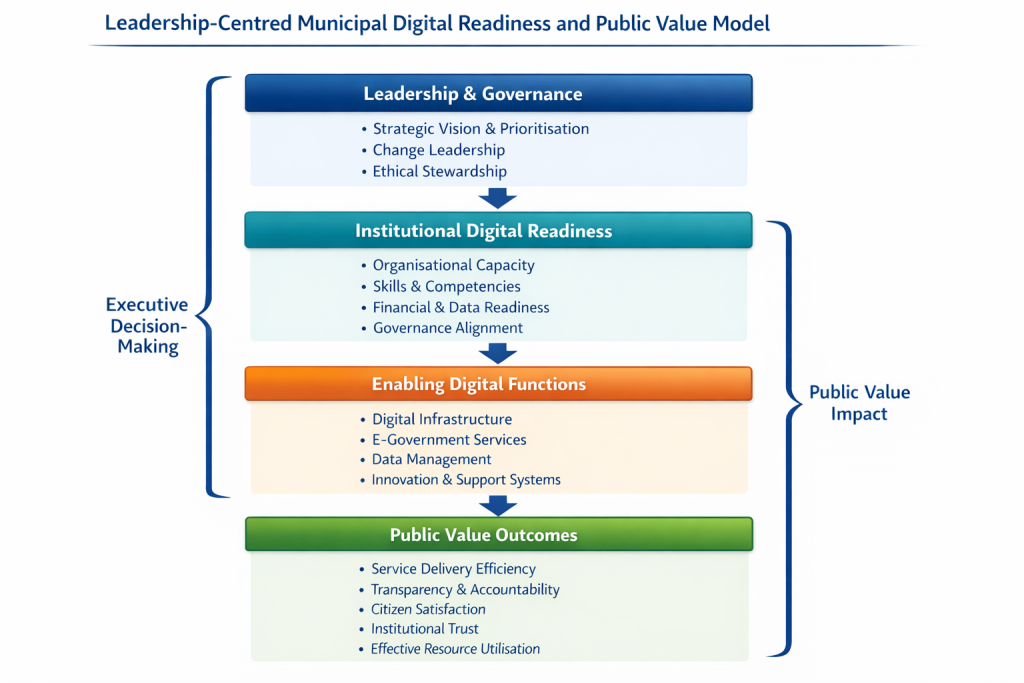
Gama’s work moves beyond traditional academic boundaries. Rather than producing a narrow case study, her research is focused on developing a scalable framework for digital public service transformation. In response, the study proposes the Leadership-Centred Municipal Digital Readiness and Public Value Model as an integrative explanatory framework. The model reframes digital transformation from a linear technology implementation sequence to a leadership-mediated decision process shaping capability development, adoption behaviour, and governance outcomes across municipalities.
Her study currently examines five municipalities, including Bela-Bela, Mossel Bay, Dr Beyers Naudé, eThekwini, and Midvaal. However, these serve as entry points into a broader question of how governments can strengthen digital readiness in ways that are practical, transferable, and context sensitive.
“My intention is not to produce a case study. It is to develop a transferable model, one that can help governments improve digital readiness and service delivery in real, practical ways,” she says.
This approach reflects a core principle of the DBL, where research is expected to contribute beyond the individual and speak to industry, society, and national development.
Reframing the Digital Transformation Challenge
A central insight emerging from Gama’s work is that digital transformation is often misunderstood.
“It is not primarily a technology problem. It is a leadership and systems problem,” she explains. Transformation does not fail because systems are absent, but because they are not led, integrated, or sustained.
This perspective underpins the Leadership-Centred Municipal Digital Readiness and Public Value Model, which positions leadership as the central coordinating mechanism in digital transformation efforts.
Many municipalities already have access to digital tools. Yet these tools are frequently underutilised, poorly integrated, or disconnected from decision-making processes. The result is not a lack of systems, but systems that fail to produce value.
“We do not lack policies or frameworks. We struggle with implementation, alignment, and accountability,” she says.
This reframing shifts attention away from simply introducing new technologies toward building the institutional conditions that allow those technologies to function effectively.
Building the Competencies That Enable Change
Through her research, Gama identifies three critical areas that determine whether digital transformation efforts succeed or fail. These dimensions are conceptualised within the Leadership-Centred Municipal Digital Readiness and Public Value Model, which integrates leadership, institutional capability, and data governance as mutually reinforcing drivers of transformation.
Leadership and Strategic Alignment
Policies often remain disconnected from execution. Without coordinated leadership and alignment across departments, initiatives struggle to gain traction.
Institutional and Technical Capability
Access to digital tools is not enough. Municipalities require the skills, governance structures, and operational systems needed to implement and sustain these tools.
Data-Driven Decision-Making
While data is generated, it is not consistently used to inform planning or monitor performance in real time. This limits responsiveness and weakens accountability.
“When these competencies are not aligned, transformation becomes fragmented. When they are integrated, we begin to see meaningful change,” she notes.
This integrated perspective reflects a systems thinking approach that is central to the DaVinci model of leadership development.
A Systems View of Public Value
Gama’s doctoral journey has reshaped how she understands the relationship between institutions and outcomes.
“What we experience as citizens is often a consequence of internal institutional failures. If the internal system is broken, the output will always be poor,” she reflects.
This insight points to a deeper structural reality. Improving service delivery is not only about external interventions but about strengthening the internal capabilities, processes, and alignment within institutions.
At the same time, she recognises a growing shift.
“There is increasing pressure to modernise and more conversations about digital transformation. The opportunity now is to move from isolated initiatives to coordinated, system-wide transformation,” she says.
Value Creation as a Guiding Principle
At the core of Gama’s work is a strong orientation toward value creation. This perspective, shaped during her earlier studies, continues to inform how she approaches both research and practice.
“If the value you create is greater than the reward you receive, then you are doing something meaningful. I want to make an impact wherever I go,” she says.
This mindset reflects a broader shift from qualification-driven learning toward contribution-driven leadership. It aligns with a DaVinci ethos that views knowledge not as an endpoint, but as a tool for enabling impact.
While her research is still in progress, she is already exploring ways to translate her insights into practical solutions that can operate within real institutional environments.
A New Expression of Leadership
Gama represents a new generation of scholar-practitioners who are redefining what it means to pursue doctoral study. Her work is not centred on academic recognition alone, but on building systems that function, institutions that deliver, and solutions that scale.
“I do not just want to study the problem. I want to be part of solving it,” she says.
This orientation reflects the intent of the DBL to develop leaders who can operate across boundaries, integrate knowledge, and contribute meaningfully to complex societal challenges.
From Research to Execution
South Africa does not lack ideas or frameworks. The persistent challenge lies in execution that is aligned, accountable, and effective. What Gama’s work represents is a shift in how this challenge is approached. It moves the conversation from designing solutions to enabling systems that can deliver those solutions consistently.
If realised, her contribution has the potential to influence not only how municipalities approach digital transformation, but how public value is created in an increasingly digital society.
By advancing the Leadership-Centred Municipal Digital Readiness and Public Value Model, her work offers a structured pathway for municipalities to move beyond fragmented initiatives toward coordinated, value-driven digital transformation.
Her work not only interrogates the challenges of digital transformation, but it also provides a model for how municipalities can lead, implement, and sustain it.

Leave a Reply