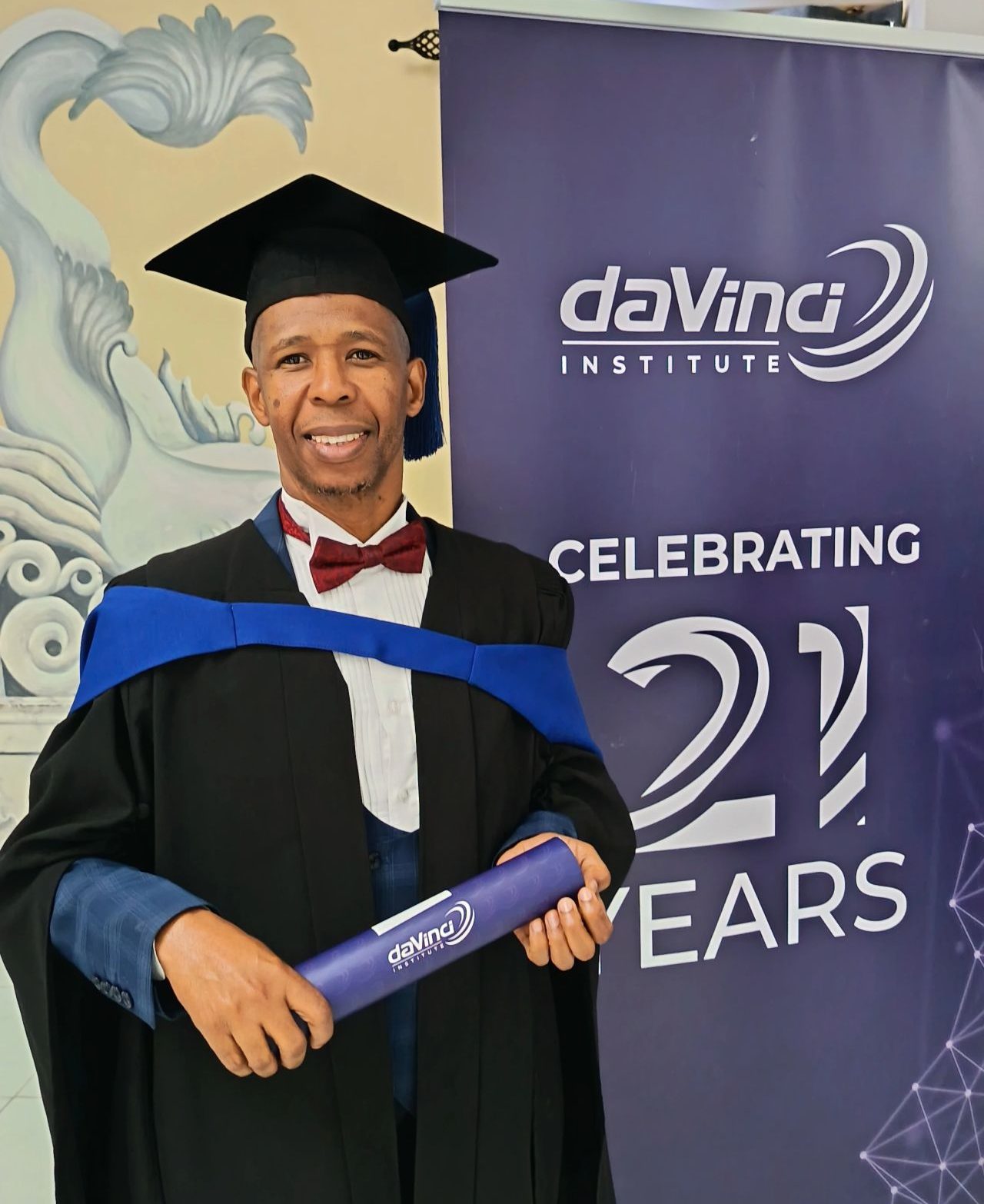
For many doctoral graduates, completing a doctorate marks the end of a demanding academic journey. For Dr Paseka Letsatsi, however, it is both an achievement worth celebrating and the beginning of a broader conversation about the future of regional integration in Southern Africa.
Dr Letsatsi, who serves as the Head of Communications at the South African Social Security Agency (SASSA), recently completed his doctoral studies at The DaVinci Institute, focusing his research on regional integration within the Southern African Development Community (SADC).
While he admits that another doctorate may be a possibility in the future, he is currently taking time to reflect on a journey that tested his resilience, challenged his thinking and expanded his understanding of the region’s interconnected future.
“The more you study, the more you want to study,” he says with a smile. “But right now, my head is still spinning. I need some time before I think about another doctorate,” says Dr Letsatsi.
From Public Service to Academic
Dr Letsatsi’s research was inspired directly by his professional experience at SASSA, where he is responsible for communication within one of South Africa’s most significant public institutions.
SASSA serves approximately 29 million social grant beneficiaries across the country. Through his work, Dr Letsatsi frequently visits border regions and witnesses the movement of people across Southern Africa.
“Many people cross borders to access services and opportunities. Observing these realities sparked my curiosity about regional integration and the extent to which countries within SADC depend on one another,” says Dr Letsatsi.
These observations at the end led him to focus his doctoral research on the opportunities and challenges of deeper regional cooperation within Southern Africa.
Having travelled extensively throughout the region and observed border dynamics firsthand, he believed SADC was the most appropriate starting point.
“I have visited many of our border posts and seen what happens on a daily basis. It made sense to begin with the region I know best,” he says.
A Journey of Perseverance
Dr Letsatsi describes his academic journey as both rewarding and demanding.
“It is a journey of love and hate. You love what you are doing, but there are times when it tests your patience and stretches your capacity,” he reflects.
Balancing the demands of a senior leadership role, family responsibilities and doctoral studies required discipline and perseverance.
“There are moments when you want to give up because the process pushes you beyond your comfort zone. But if you remain focused and committed, you discover abilities you did not know you had,” he says.
The experience has already begun to create opportunities for broader engagement. Following presentations based on his research, Dr Letsatsi has received invitations to continue contributing to discussions on regional integration.
“Being invited back to share my work tells me that the research is adding value and contributing to important conversations,” says Dr Letsatsi.
The DaVinci Difference
Throughout his studies, Dr Letsatsi found value in The DaVinci Institute‘s distinctive approach to education, particularly its emphasis on innovation, technology and systems thinking.
He credits both his supervisor and the institution’s supportive environment for helping him navigate the complexities of doctoral research.
“My supervisor constantly challenged me to think differently about innovation, technology and systems. The support structures available through Da Vinci made a significant difference throughout my journey,” says Dr Letsatsi.
He believes the institution’s practical and future-focused approach creates an environment where students are encouraged not only to generate knowledge but also to apply it to real-world challenges.
Rethinking Regional Integration
Central to Dr Letsatsi’s research is the argument that Southern African countries are already deeply interconnected and that stronger regional integration could open significant social and economic benefits.
His research advocates for the controlled free movement of people, enhanced technology at border posts, improved movement of goods and services, and stronger collaboration among SADC member states.
“The sooner we realise that our economies are dependent on one another, the sooner we can open the full potential of regional development,” says Dr Letsatsi.
He points to practical examples of this interdependence. Gauteng, for instance, receives a substantial portion of its water supply from Lesotho, while South Africa continues to rely on regional partnerships for electricity, labour and trade.
“If one country suddenly withdrew critical resources, the impact would be enormous. The reality is that we are already interconnected, whether we recognise it or not,” he says.
His research also highlights the human dimension of regional integration. In many border communities, families and cultural ties extend across national boundaries, creating a natural need for easier movement and cooperation.
“I am not advocating for uncontrolled movement. What I am proposing is smarter, technology-enabled systems that make movement easier while maintaining security and oversight,” says Dr Letsatsi.
Moving Beyond Policy to Implementation
While many regional development frameworks and policies already exist, Dr Letsatsi believes the greatest challenge lies in implementation.
“We do not have a shortage of policies or plans. What we often lack is effective monitoring, evaluation and accountability,” says Dr Letsatsi.
According to him, stronger institutional integrity and more rigorous follow-through are essential if regional integration goals are to be realised.
“We know where we want to go. The question is whether we are serious about measuring progress and implementing what has already been agreed upon,” he says.
He argues that governments across the region must invest more heavily in monitoring and evaluation systems to ensure that developmental commitments translate into meaningful outcomes.
Advice for Future Doctoral Candidates
Looking back on his own experience, Dr Letsatsi encourages aspiring doctoral students to approach their studies with clarity, discipline and determination.
“You must remain focused on what you want to achieve. Once you start this journey, your studies will become your baby,” he says.
He emphasises the importance of building a strong support system that includes family, employers and colleagues.
“When you are balancing work, family and research, support becomes critical. There will be times when your studies demand significant amounts of your attention, and having people who understand that makes a tremendous difference,” says Dr Letsatsi.
Building Knowledge for a More Connected Future
Although Dr Letsatsi plans to take a well-earned break before considering further studies, his research has already contributed valuable insights into the future of Southern Africa.
By exploring the role of technology, policy implementation and regional cooperation, his work challenges leaders, policymakers and institutions to rethink how the region can work together more effectively.
His message is clear: regional integration is not merely a policy aspiration, it is an economic, social and developmental necessity.
As Southern Africa continues to navigate increasingly complex challenges and opportunities, Dr Letsatsi’s research provides a timely reminder that the region’s future prosperity will depend not only on national success but also on collective progress.
Leave a Reply