
Category: Research

  • Rethinking Enterprise And Supplier Development In South Africa’s Mining Communities

    Rethinking Enterprise And Supplier Development In South Africa’s Mining Communities

    South Africa’s mining sector has long been positioned as a driver of economic development. However, for many mining host communities, the lived experience tells a different story. Despite the implementation of Enterprise and Supplier Development (ESD) initiatives, communities located near mining operations continue to face deep socio-economic challenges.

    This research by Dr Bheki Mdakane explored the social, economic, and political experiences of mining host communities in the Northern Cape, focusing specifically on how ESD initiatives impact local SMMEs and broader community development.

    A Qualitative Lens on Community Realities

    Dr Bheki Mdakane

    The study adopted a qualitative, interpretivist case-study approach, enabling an in-depth understanding of complex, real-world experiences. Through interviews with 18 participants, including SMME representatives within mining communities, the researcher captures nuanced perspectives that quantitative methods often overlook.

    By immersing himself in the community over several years, the researcher ensured that the findings reflect lived realities rather than abstract assumptions.

    Key Findings: Tensions, Misalignment, and Missed Opportunities

    1. Persistent Stakeholder Tensions

    The study highlights the ongoing conflict between three key stakeholders:

    • Government institutions
    • Mining companies
    • Host communities

    These tensions are largely driven by misaligned expectations and limited engagement, often resulting in protests and hostility from local SMMEs.

    2. A Critical Flaw: Defining “Community.”

    One of the most significant findings is that ambiguity in defining who qualifies as a “host community” undermines development efforts. This lack of clarity creates exclusion, resentment, and inequitable access to opportunities.

    3. Mixed Impact of ESD Initiatives

    While ESD programmes have introduced some benefits, their overall impact is inconsistent:

    • Positive: Skills development, training, and limited economic participation
    • Negative: Poor implementation, limited access, and lack of sustainability

    This results in uneven development outcomes across communities.

    4. Skills Development Misalignment

    Training and capacity-building initiatives often fail to align with:

    • Actual local economic opportunities
    • SMME needs
    • Market demands

    This disconnect reduces the effectiveness of development programmes and limits long-term impact.

    5. Absence of Conflict Resolution Mechanisms

    • A major structural gap identified is the lack of formal dispute resolution systems between mining companies and host communities.
    • Without such mechanisms, tensions escalate into protests, disrupting both community stability and mining operations.

    Beyond Mining: A Broader Development Challenge

    The study situates mining-related challenges within a wider socio-economic context. It argues that development failures are not only operational but systemic, shaped by:

    • Weak stakeholder coordination
    • Policy-practice gaps
    • Historical inequalities

    Importantly, the research notes that models from developed countries cannot simply be applied to South Africa, given its unique socio-political landscape.

    Towards a New Framework for Inclusive Development

    To address these challenges, the study proposes a more integrated and strategic approach, including:

    • Clear definition of host communities to ensure fair inclusion
    • Strengthened stakeholder engagement frameworks
    • Alignment of skills development with economic realities
    • Establishment of independent dispute resolution mechanisms
    • More accountable and context-specific ESD implementation

    These interventions aim to move beyond compliance-driven approaches toward genuine, inclusive economic participation.

    Conclusion: From Compliance to Co-Creation

    This research revealed that while ESD initiatives hold promise, their current implementation often falls short of transforming mining host communities. The solution lies not in more policies, but in better alignment, deeper engagement, and shared value creation.

    In the end, meaningful development in South Africa’s mining regions will require a shift from transactional relationships to collaborative partnerships between communities, industry, and government.


  • Service Delivery And Departmental Performance In Tshwane

    Service Delivery And Departmental Performance In Tshwane

    Service delivery sits at the heart of South Africa’s post-1994 democratic project, which envisioned municipalities as developmental local governments tasked with driving economic growth, reducing poverty and inequality, and leading social transformation. Yet, despite strong constitutional and policy foundations, many municipalities remain distressed, dysfunctional, and unable to realise this vision.

    The study by Dr Thabo Moses Ramodula, doctoral alumnus of The DaVinci Institute, interrogated one of the most pressing governance questions in South Africa’s democratic project: why does the vision of developmental local government remain largely unrealised despite extensive strategic planning and policy frameworks?

    Situated within the intellectual tradition of The DaVinci Institute, an institution known for advancing systems thinking, innovation, and strategic leadership in complex environments, this doctoral study explores the critical nexus between strategy and vision in the South African local government system.

    This study investigates a critical question:

    What is the relationship between municipal strategy and the vision of developmental local government?

    At its core, the research explored whether municipal strategies genuinely advance the developmental vision or whether a disconnect between vision and strategy undermines performance.

    The Vision: Developmental Local Government

    The White Paper on Local Government (1998) defines developmental local government as a municipality committed to:

    • Maximising social development and economic growth
    • Integrating and coordinating development efforts
    • Democratising development through community participation
    • Leading and learning as adaptive institutions

    This vision moves municipalities beyond basic service delivery toward becoming drivers of local economic development, social inclusion, and long-term transformation.

    However, the study finds that while this vision is clearly articulated in policy, its translation into practice remains inconsistent.

    Strategy in Municipal Practice

    In theory, strategy bridges the gap between a desired future (vision) and current reality. Drawing from military origins and corporate practice, strategy involves:

    • Long-term orientation
    • Clear resource allocation
    • Organisational alignment
    • Leadership direction
    • Continuous evaluation

    In South African municipalities, strategy is primarily operationalised through the Integrated Development Plan (IDP), a five-year planning instrument required by legislation.

    While the IDP is comprehensive and procedurally compliant, the study argues that it often reflects a linear, compliance-driven planning exercise, rather than a holistic, long-term strategic approach anchored in the developmental vision.

    Research Design and Case Studies

    The study adopted a qualitative, multi-site case study approach across three municipalities:

    Through interviews, document analysis, and thematic coding, the research examined how each municipality conceptualised and implemented a strategy in relation to its vision.

    Key Findings

    1. A Weak Strategy-Vision Nexus

    The central finding is that the connection between municipal strategy and the developmental vision lacks consistency, particularly in traditional municipalities like RLM and MMM.

    Frequent political turnover leads to:

    • Shifting priorities
    • Changing visions with new incumbents
    • Fragmented long-term continuity

    Strategy becomes tied to political cycles rather than intergenerational developmental objectives.

    2. Dominance of Compliance Over Strategy

    Municipal strategy is heavily influenced by:

    • Legislative compliance requirements
    • Budget cycles
    • Reporting frameworks
    • Audit pressures

    This results in a focus on procedural correctness rather than transformative developmental outcomes. Strategy becomes administrative rather than visionary.

    3. Political Tenure Undermines Continuity

    The five-year electoral cycle creates structural instability:

    • New mayors introduce new visions
    • Long-term strategies are interrupted
    • Institutional memory weakens
    • Development initiatives lose momentum

    In contrast, Orania demonstrated stronger continuity due to ideological cohesion and leadership stability, resulting in a clearer alignment between vision and strategy.

    4. Institutional Capacity and Ethical Leadership

    • Municipal distress is exacerbated by:
    • Weak institutional capacity
    • Skills shortages
    • Inadequate performance management
    • Ethical leadership deficits
    • Untapped grants and resource inefficiencies

    The study emphasises that strategy requires not only plans, but capable and ethical actors who understand and own the vision.

    5. Historical and Structural Constraints

    The legacy of apartheid spatial planning, liberation movement politics, and macroeconomic challenges continues to shape municipal realities. These systemic pressures complicate the implementation of a developmental agenda.

    Theoretical Contribution

    The research reintroduces strategy through its military etymology, emphasising:

    • Strategy as intergenerational leadership
    • Long-term orientation over short-term compliance
    • Systems thinking
    • Alignment between structure and purpose

    The study broadens municipal strategy beyond planning tools like IDPs and argues for strategy as a dynamic, vision-driven phenomenon.

    Proposed Framework: A Holistic Approach to Municipal Strategy

    The study proposes a framework built around:

    1. Vision Primacy

    The developmental vision must precede and shape strategy, not the other way around.

    2. Long-Term Growth and Development Strategy (GDS)

    Municipalities should adopt long-term strategies aligned with the National Development Plan (NDP), extending beyond political terms.

    3. Key Actors in Strategy-Vision Alignment

    • Local community
    • Political leadership
    • Municipal administration
    • Economic development stakeholders

    4. Structural and Performance Alignment

    Strategy must influence:

    • Resource allocation
    • Organisational design
    • Performance management systems
    • Learning and adaptation processes

    Practical Implications

    To strengthen the strategy-vision nexus, municipalities should:

    • Institutionalise long-term strategy beyond political cycles
    • Strengthen ethical leadership and meritocracy
    • Improve performance management systems
    • Legislate developmental mandates more robustly
    • Focus on local economic development as a core strategy driver

    Without structural continuity and leadership alignment, compliance will continue to dominate transformation.

    Conclusion

    The study concluded that South Africa’s local government crisis is not primarily a failure of policy vision, but a failure of strategic alignment and continuity. The vision of developmental local government remains compelling and constitutionally grounded. However, its realisation depends on:

    • Moving beyond reductionist planning
    • Reclaiming strategy as long-term leadership
    • Embedding continuity across political transitions
    • Building institutional capacity with ethical foundations

    At the end, developmental local government will only emerge where strategy is not merely a document, but a sustained, intergenerational commitment to transformation.

  • The Role Of Agricultural Colleges In Advancing Sustainable Community Development

    The Role Of Agricultural Colleges In Advancing Sustainable Community Development

    Sustainable agricultural development remains central to South Africa’s rural transformation agenda. In a context marked by poverty, inequality, land reform challenges, and climate pressures, agricultural colleges have a potentially strategic role to play in strengthening rural economies. The doctoral study by Dr Modise Philemon Tshwana examined this role through a case study of Tompi Seleka College of Agriculture (TSCA) in Limpopo Province, while drawing comparative insights from five other agricultural colleges in South Africa.

    Repositioning Agricultural Colleges for Development

    Historically, agricultural colleges have focused primarily on technical farming knowledge and production skills. However, this study argued that their mandate should extend beyond training to include active participation in socio-economic development, entrepreneurship support, stakeholder engagement, and community empowerment.

    Using an interpretivist, qualitative research approach, the study engaged 120 participants, including farmers, alumni, students, lecturers, traditional leaders, development forums, management staff, and external stakeholders. Data were collected through structured questionnaires, interviews, focus group discussions, participant observation, and analysed using ATLAS software.

    Key Findings

    1. Relevance of Agricultural Training

    The research found that the diploma programmes offered by agricultural colleges, including TSCA, are validated and endorsed by relevant industry stakeholders. The curriculum aligns broadly with agricultural sector needs, particularly in plant and animal production.

    However, while technically sound, programmes require stronger integration of:

    • Entrepreneurial development
    • Sustainable farming practices
    • Climate change adaptation
    • Community-based agricultural innovation

    2. Policy Environment: Present but Not Fully Optimised

    South Africa has a comprehensive agricultural policy framework aligned with:

    • The National Development Plan (NDP)
    • Comprehensive Africa Agriculture Development Programme (CAADP)
    • Sustainable Development Goals (SDGs)
    • Provincial agricultural mandates

    The study found that while policies exist to guide colleges toward rural development, implementation gaps remain. Some policies require contextual modification to better support local realities, especially in rural provinces like Limpopo.

    3. Infrastructure and Resource Constraints

    A major constraint identified is insufficient infrastructure and equipment. Challenges include:

    • Shortage of qualified lecturers
    • Limited technological systems
    • Inadequate modern irrigation and research facilities
    • Weak administrative and library systems

    These resource limitations hinder colleges from fully delivering on both Further Education and Training (FET) and Higher Education and Training (HET) mandates.

    4. Community Impact and Stakeholder Relationships

    The study confirms that agricultural colleges contribute meaningfully to:

    • Farmer skills development
    • Improved agricultural production
    • Youth training
    • Extension services support

    However, to maximise socio-economic impact, colleges must deepen collaboration with:

    • Traditional authorities
    • Development forums
    • Government departments
    • Industry partners

    The research emphasises that no single institution can drive rural development alone; sustainable outcomes depend on coordinated stakeholder engagement.

    A Systems Thinking Approach

    Dr Modise Philemon Tshwana

    The study adopted systems thinking as its theoretical lens, recognising agricultural colleges as open systems influenced by multiple internal and external forces. Sustainable development, therefore, requires integrated responses rather than isolated technical training interventions.

    Knowledge production is positioned as “Mode 2,” socially distributed, context-driven, and problem-oriented, reinforcing the importance of collaboration between colleges and their surrounding communities.

    Proposed Governance Framework

    A significant contribution of the study is the development of a conceptual framework to guide agricultural colleges. The framework proposes seven pillars:

    • Managing climate change
    • Clear and responsive policies
    • Protection from political interference
    • Strong stakeholder engagement
    • Improved infrastructure and training facilities
    • Encouraging research and technology adoption
    • Strengthening vocational and practical training

    Additionally, the study proposes a reputation management framework to improve service quality, organisational identity, and stakeholder trust, positioning colleges as credible development partners.

    Conclusion: From Training Institutions to Development Catalysts

    The study concluded that agricultural colleges could play a transformative role in sustainable community development, but only if they reposition themselves strategically.

    To move beyond traditional technical training, colleges must:

    • Align programmes with rural socio-economic realities
    • Invest in infrastructure and human capital
    • Strengthen stakeholder partnerships
    • Embrace entrepreneurship and innovation
    • Integrate sustainability into curricula

    When effectively supported and strategically governed, colleges like Tompi Seleka can become catalysts for rural renewal, food security, employment creation, and inclusive economic growth in South Africa.

  • How Entrepreneurs Succeed When Resources Are Scarce

    How Entrepreneurs Succeed When Resources Are Scarce

    Why does effectuation and bricolage matter in developing economies? Entrepreneurship is widely recognised as a critical lever for economic growth and job creation, particularly in developing countries where formal employment opportunities are limited. Yet for many aspiring entrepreneurs, especially young people and graduates, the reality of starting and sustaining a business is shaped by severe resource constraints: limited access to finance, weak institutional support, and fragile economic conditions.

    A doctoral study conducted by The DaVinci Institute’s alumnus, Dr Jerimaya Mundondo, explored how entrepreneurs navigate these constraints and what enables some to move from intention to action, and ultimately to success. 

    Rethinking entrepreneurship in resource-constrained environments

    Traditional models of entrepreneurship often assume access to capital, networks, and stable markets. In contrast, entrepreneurs in contexts such as Zimbabwe and other developing economies must frequently “create something from nothing.” Dr Mundondo’s study argued that resourcefulness, rather than resource abundance, is the decisive factor.

    The research focuses on two entrepreneurial approaches particularly relevant to such environments:

    • Effectuation: starting with available means (who you are, what you know, and whom you know) and allowing goals to emerge over time, rather than pursuing fixed plans.
    • Bricolage: creatively recombining and repurposing existing resources to solve new problems, even when those resources were not originally intended for that use.

    Both approaches challenge the idea that entrepreneurship requires prior access to substantial resources.

    What the study examined

    Using a quantitative, cross-sectional research design, the study surveyed:

    • Nascent entrepreneurs (students from two universities), representing individuals still forming entrepreneurial intentions or beginning early activities.
    • Emerging entrepreneurs (members of the SME Association of Zimbabwe) represent individuals already engaged in venture creation and growth.

    In total, over 900 respondents participated. The study examined how effectuation and bricolage influence:

    • Entrepreneurial intentions: the desire and commitment to start a business
    • Entrepreneurial behaviour: concrete actions taken to create a venture
    • Perceived entrepreneurial success: entrepreneurs’ assessment of venture progress and outcomes

    Advanced statistical techniques, including regression analysis and Partial Least Squares Structural Equation Modelling (PLS-SEM), were used to test the relationships.

    Key findings

    The results reveal a nuanced picture of how resourceful behaviours operate at different stages of the entrepreneurial journey.

    For nascent entrepreneurs:

    • Both effectuation and bricolage positively influence entrepreneurial intentions.
    • Bricolage also supports early entrepreneurial behaviour, helping individuals act despite limited resources.
    • However, effectuation did not significantly influence behaviour at this early stage, suggesting that planning flexibility alone may not be enough to trigger action without hands-on resource improvisation.

    For emerging entrepreneurs:

    • Effectuation strongly influences both entrepreneurial behaviour and perceived success, indicating its importance once ventures are underway.
    • Bricolage plays a more limited role at this stage, showing weaker and sometimes insignificant effects on behaviour and success.
    • In short, bricolage appears especially valuable for getting started, while effectuation becomes more important for sustaining and scaling entrepreneurial activity.

    Bridging the intention-action gap

    One of the study’s most important contributions is its insight into the intention-behaviour gap, a well-documented challenge where many individuals express a desire to start a business but fail to act.

    The findings suggest that resourceful behaviours help close this gap by:

    • Reframing how entrepreneurs perceive constraints
    • Reducing dependence on external funding
    • Encouraging experimentation, partnerships, and incremental progress

    Rather than waiting for ideal conditions, entrepreneurs who adopt effectuation and bricolage act with what is already available.

    Why this matters for policy and institutions

    Dr Mundondo’s study concluded that entrepreneurship support in developing economies must move beyond access-to-finance narratives. Instead, institutions, universities, and policymakers should actively cultivate resourceful entrepreneurial mindsets.

    Key implications include:

    • Embedding effectuation and bricolage into entrepreneurship education
    • Designing incubators and accelerators that emphasise experimentation and partnerships, not only funding
    • Creating policy environments that recognise informal resource mobilisation as legitimate entrepreneurial practice

    A shift in how success is enabled

    Entrepreneurship in resource-constrained environments is not primarily a story of shortage; it is a story of ingenuity. This research demonstrates that when entrepreneurs learn how to think and act resourcefully, they are better equipped to turn intentions into action and action into impact. In contexts where resources are scarce, how entrepreneurs think about resources may matter more than how many they have.

  • A Knowledge Management Framework For Competitive Advantage In Botswana’s Mobile Network Operators

    A Knowledge Management Framework For Competitive Advantage In Botswana’s Mobile Network Operators

    This doctoral study by The DaVinci Institute’s alumnus, Gabapelo Emmanuel Phillip, investigated how Knowledge Management (KM) can be leveraged to enhance competitive advantage among selected Mobile Network Operators (MNOs) in Botswana, particularly in the context of the Fourth Industrial Revolution (4IR). The research responded to a critical gap: despite rapid digital transformation and the strategic importance of knowledge in telecommunications, KM practices in Botswana’s MNOs remain fragmented, ad hoc, and poorly aligned with 4IR capabilities.

    Knowledge-Intensive and Technology-Driven Environment

    The study is grounded in the reality that the telecommunications sector is knowledge‑intensive, data‑rich, and increasingly complex due to technologies such as artificial intelligence, big data analytics, cloud computing, and the Internet of Things. While these technologies offer immense opportunities, the research finds that Botswana’s MNOs have not fully translated them into structured KM practices that support learning, decision‑making, and sustained competitiveness.

    Research Methodology

    DR GABAPELO EMMANUEL PHILLIP
    Meet DaVinci Doctoral Graduate, Dr Gabapelo Phillip

    Using a qualitative, interpretivist research approach, the study collected data through semi‑structured interviews with employees from selected MNOs (notably BTCL and Mascom Wireless). The findings reveal that although elements of KM exist, such as information systems, training initiatives, and digital tools, these are often implemented in silos, without a coherent framework or governance structure. As a result, critical organisational knowledge is inconsistently captured, poorly shared, and at risk of being lost through employee turnover.

    Theoretical Foundations

    The research draws on and synthesises three key theoretical perspectives:

    • The Knowledge‑Based View (KBV) of the firm
    • Systems Theory
    • The Knowledge Management Success Model

    Development of the 4IR‑Aligned KM Framework

    Through this synthesis, the study develops a 4IR‑aligned conceptual Knowledge Management framework tailored to the Botswana telecommunications context. The framework emphasises nine interrelated determinants of KM success, including:

    • digital technology enablement,
    • people‑centred KM practices,
    • process alignment,
    • KM system and content quality,
    • leadership commitment,
    • knowledge‑friendly organisational culture,
    • governance and policy structures,
    • integration with business strategy, and
    • the application of systems thinking to manage organisational complexity.

    Central Argument of the Study

    A central argument of the study is that KM cannot succeed as a purely technological initiative. Instead, effective KM requires the integration of technology, people, processes, and culture, supported by leadership and aligned with organisational strategy. The study further contends that systems thinking is essential for navigating the complexity introduced by the 4IR, as it enables organisations to understand interdependence, knowledge flows, and feedback loops across the enterprise.

    Contributions of the Research

    Theoretical Contributions

    Integration of KM, 4IR, and systems thinking into a unified conceptual framework.

    Methodological Contributions

    Provision of a structured, context‑sensitive approach to KM deployment in developing economies.

    Practical Contributions

    Actionable guidance for MNOs, policymakers, and practitioners to improve KM maturity, operational efficiency, and innovation capacity.

    Societal and PolicyRelated Contributions

    Support for Botswana’s national digital transformation goals under Vision 2036 and related development plans.

    Conclusion

    In conclusion, the study finds that without a coordinated and 4IR‑aligned KM framework, Botswana’s MNOs risk underutilising their most critical strategic asset, knowledge. The proposed framework provides a blueprint for transforming KM from a fragmented support activity into a core driver of competitive advantage, organisational learning, and long‑term sustainability in the telecommunications sector.

  • Investigating The Relationship Between Work-From-Home And Employee Productivity

    Investigating The Relationship Between Work-From-Home And Employee Productivity

    The DaVinci Institute’s alumnus, Lunga Samuel Mziwake’s research, investigated whether and how work-from-home (WFH) practices influence employee productivity among office-based employees at a large, listed South African mining company. Although WFH became widespread during COVID-19, its impact on productivity in traditionally structured industries like mining was unclear and under-researched.

    Research Problem

    Lunga Samuel Mziwake
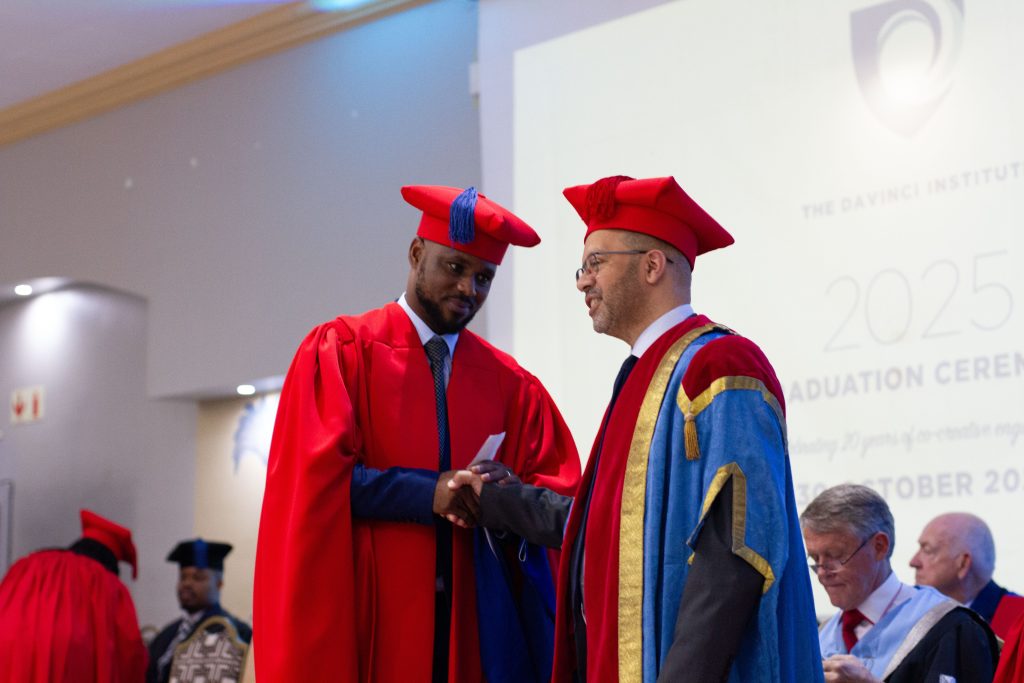
    Lunga Samuel Mziwakhe, proudly captured in his graduation gown after completing his Master of Business Leadership (MBL) at The DaVinci Institute on 30 October, marking a milestone in a research journey that bridges academic insight and organisational practice.

    While WFH offers benefits such as flexibility and work-life balance, managers in the mining sector expressed mixed views about its effect on productivity. There was:

    • Limited empirical evidence from the mining industry,
    • Uncertainty about whether WFH improves or harms productivity, and
    • No clear guidance for HR managers on how to optimise WFH arrangements.

    This created a need to empirically test the relationship between WFH and productivity in this specific organisational context.

    Theoretical Framework

    The study is grounded in three key theories:

    • Job Demands-Resources (JD-R) Model: WFH can reduce demands (e.g., commuting) and increase resources (e.g., autonomy).
    • Self-Determination Theory (SDT): productivity improves when autonomy, competence, and relatedness are satisfied.
    • Contingency Theory: management practices (including WFH) must fit the organisational context.

    Methodology

    • Approach: Quantitative, deductive, post-positivist.
    • Design: Cross-sectional survey.
    • Sample: 33 office-based employees from the mining company.

    Instruments:

    • Flexible Work Options Questionnaire (FWOQ)
    • Employee Productivity Questionnaire (EP)
    • Analysis: Descriptive statistics, correlation analysis, and regression modelling.

    Key Findings

    • WFH has a positive relationship with employee productivity.
    • Employees who worked from home reported higher productivity overall.

    Gender differences emerged:

    • WFH significantly increased productivity for male employees.
    • The relationship was not statistically significant for female employees, suggesting different flexibility or support needs.

    Factors influencing productivity when working from home included:

    • Work-life balance,
    • Distractions at home,
    • Access to technology,
    • Autonomy,
    • Social isolation,
    • Communication and collaboration.
    • Context matters.

    The effectiveness of WFH depends on job type, technological access, employee characteristics, and organisational support.

    Recommendations

    The study recommends that the company:

    • Improve work-life balance support,
    • Assist employees in managing home-based distractions,
    • Provide adequate technology and infrastructure,
    • Support employee autonomy while ensuring accountability,
    • Address social isolation through structured communication,
    • Provide training on remote work skills and mental well-being,
    • Offer additional flexibility and support for female employees.

    It also recommends future research using longitudinal designs, larger samples, and deeper exploration of psychological and social factors.

    Conclusion

    The study concluded that WFH can enhance productivity in a South African mining company, but its success depends on how it is implemented and supported. A one-size-fits-all approach is ineffective; instead, flexible, context-specific, and inclusive strategies are required.

  • Enablers And Barriers To Learning Transfer Into The Workplace: An Exploration of Company-Sponsored Graduates

    Enablers And Barriers To Learning Transfer Into The Workplace: An Exploration of Company-Sponsored Graduates

    What are the enablers and barriers to learning transfer into the workplace? Organisations in South Africa invest heavily in employee education. Through legislated skills development frameworks, companies sponsor employees to complete formal qualifications, often through higher education institutions. In return, organisations expect improved capability, performance, and competitive advantage.

    Yet, despite these investments, learning does not consistently translate into changed behaviour, improved practice, or organisational value. This gap between learning and learning transfer formed the focus of a recent qualitative study conducted among company-sponsored graduates.

    The DaVinci Institute’s alumna, Meggie Siddiah W Muthee study has explored a critical question: What enables or prevents employees from transferring what they learn into their workplaces after completing a sponsored qualification?

    Learning transfer is not automatic

    A central finding of the study is that learning transfer is not guaranteed. While learning almost always occurs, its transfer into the workplace is often:

    • Unintentional
    • Inconsistent
    • Informal
    • Unmeasured
    • Dependent on individual initiative

    As a result, learning transfer is largely serendipitous rather than strategically designed or supported by organisations.

    This means organisations are often not fully realising the return on their investment in employee education, even when qualifications are completed.

    Enablers and barriers exist on three levels

    The study identified that learning transfer is shaped by the interaction of three systems:

    • The individual (the graduate)
    • The organisation (the workplace)
    • The qualification provider (the education institution)

    Each system can either enable or inhibit transfer.

    Key Enablers Include:

    • Supportive line managers and peers
    • Organisational cultures that value learning and experimentation
    • Roles that allow space to apply new knowledge
    • Relevant, practical, and applied curricula
    • Opportunities to reflect, share, and experiment with learning
    • Recognition and feedback when learning is applied

    Key Barriers Include:

    • Heavy workloads and lack of time
    • Lack of organisational ownership for learning transfer
    • No shared understanding of what “learning transfer” means
    • Learning is seen as separate from “real work.”
    • Rigid roles with no room for innovation or experimentation
    • Poor alignment between what is taught and workplace realities

    Interestingly, many factors were found to be dual in nature, capable of acting as either enablers or barriers depending on how they are enacted. For example, organisational culture, leadership, and performance management can either stimulate learning transfer or suppress it.

    Organisations play the strongest influencing role

    Although the decision to transfer learning is ultimately individual, the study found that organisations exert the strongest influence over whether transfer occurs.

    Employees are more willing and able to transfer learning when:

    • Learning is explicitly valued by the organisation
    • Managers show interest in what employees are learning
    • Space is created to apply, test, and refine new ideas
    • Learning is connected to organisational goals and challenges
    • Transfer is expected, discussed, and supported

    When organisations fail to create these conditions, even highly motivated graduates struggle to apply what they have learned.

    Graduates use their own strategies to transfer learning

    In the absence of formal organisational processes, graduates often rely on personal strategies, such as:

    • Actively seeking managerial buy-in
    • Informally involving colleagues
    • Translating theory into small practical experiments
    • Being self-directed and reflective
    • Sharing insights through conversations rather than formal channels

    While these strategies sometimes succeed, they place the burden of learning transfer almost entirely on the individual, making transfer fragile, uneven, and dependent on personal resilience.

    Learning has value even when it is not transferred

    The study also highlights that learning creates value beyond immediate organisational application. Graduates reported:

    • Increased confidence and professional identity
    • Improved problem-solving ability
    • Greater strategic and systems thinking
    • Enhanced personal growth and career mobility

    However, when this learning is not absorbed into the organisation, its full collective value is lost and may even benefit competitors when employees move on.

    From Serendipity to Strategy

    The study concludes that learning transfer should not be left to chance. Instead, it should be:

    • Designed intentionally
    • Supported structurally
    • Aligned strategically
    • Owned collectively

    Recommendations

    It recommends that organisations, qualification providers, and learners work together as a learning transfer system rather than as separate actors.

    In practical terms, this means:

    • Organisations embedding learning into the purpose of work
    • Managers are being developed as learning facilitators, not just performance supervisors
    • Qualifications are being designed with application and workplace relevance in mind
    • Graduates are being supported as active agents of change, not passive recipients of knowledge

    Conclusion

    This research reframes learning transfer not as an individual responsibility alone, but as a systemic organisational capability. If organisations want education investments to deliver real value, they must move beyond compliance and completion and begin designing environments where learning can live, grow, and be used. Learning changes people. Only learning transfer changes organisations.

  • Public Funding Of The College Sector: A Social Return On Investment In Higher Education In South Africa

    Public Funding Of The College Sector: A Social Return On Investment In Higher Education In South Africa

    Is there a social return on investment in higher education? Dr Cornelia Carol September’s doctoral study examined whether South Africa’s substantial public investment in Technical and Vocational Education and Training (TVET) colleges yields tangible social and developmental benefits. The research is framed within the context of South Africa as a developmental state, one that uses education as a strategic tool for transformation, equality, and economic growth.

    Background and Rationale

    Despite substantial budgetary allocations, including over R10 billion to the TVET sector in 2018/19, questions persist about the efficiency, accountability, and outcomes of this investment. While access has increased through free tuition, transport, and allowances, challenges such as low completion rates, limited labour market absorption, and poor institutional prestige undermine social and economic returns.

    The study is motivated by the need for a Social Return on Investment (SROI) framework, an approach that goes beyond financial metrics to include social, economic, and community benefits derived from education.

    Theoretical Framework

    Grounded in Marxist dialectical materialism, the research views education as a mechanism for societal transformation rather than a mere economic tool. Marxist theory asserts that education should reproduce social equity and collective advancement, aligning with the aims of a developmental state.

    Research Aim and Objectives

    The study sought to:

    • Examine the rationale behind increasing TVET funding.
    • Analyse existing policy frameworks and their ability to demonstrate ROI.
    • Investigate the usefulness of SROI in shaping funding policies.
    • Develop a conceptual framework for measuring SROI in South Africa’s college sector.

    Research Methodology

    A qualitative, grounded theory approach was adopted. Nineteen participants, including government officials, TVET principals, policy experts, and international specialists, were interviewed. Data was collected through online platforms due to COVID-19 restrictions.

    The analysis was interpretive, relying on inductive reasoning and thematic categorisation to build theory from participant experiences and policy review.

    Key Themes and Findings

    Seven core themes emerged from the data:

    Aspiring Developmental State

    • South Africa’s investment in TVET should strengthen state capability and technical capacity. However, governance gaps and fragmented implementation hinder progress toward a mature developmental state.

    Finance for Responsive Change

    • Funding mechanisms are misaligned with social outcomes. Instead of focusing on enrolment numbers, financing should reward qualitative improvements such as employability and social inclusion.

    Judging TVET Policy in Real Life

    • Policy frameworks appear progressive but lack translation into practical, measurable outcomes at the institutional level.

    Comparators and Dimensions

    • International benchmarks (e.g., Korea and Singapore) highlight how coordinated policies, industry partnerships, and data-driven governance can yield higher returns.

    Agility and Efficiency towards Greater Quality

    • TVET institutions remain underfunded and struggle to adapt to economic changes. Participants emphasised the need for agility, flexibility, innovation, and responsiveness to enhance quality and prestige.

    Understanding Social Return on Investment

    SROI measures the broader value of education, including community well-being, civic participation, and equity, rather than just financial returns. Participants agreed that adopting this framework would strengthen accountability and evidence-based planning.

    International Approaches

    The study drew lessons from Russia’s and Australia’s models, which enforce shared responsibility between government, industry, and students through contractual commitments that ensure employability and reinvestment in education.

    Conclusions

    The research concluded that while public funding for TVET colleges has expanded, South Africa has not yet achieved measurable social returns proportional to the investment. A disjuncture exists between funding inputs and developmental outcomes, with limited data integration and weak monitoring systems.

    A Social Return on Investment (SROI) framework is proposed to:

    • Align financial expenditure with qualitative outcomes.
    • Promote shared accountability among stakeholders.
    • Embed social value in policy, planning, and evaluation.

    Recommendations

    • Develop an SROI-Based Funding Model: Shift from quantitative (enrolment-driven) to qualitative (impact-driven) financing.
    • Strengthen Partnerships: Establish formal agreements between government, industry, and students to ensure mutual accountability.
    • Enhance Data Systems: Integrate social, health, and employment data to evaluate real community impact.
    • Capacity Building: Equip TVET colleges with tools to measure and report social value effectively.

    Limitations and Future Research

    The study was limited to public colleges reporting to the Department of Higher Education and Training (DHET), excluding those under other departments. Future research should broaden the scope and test the proposed SROI framework through pilot projects in selected TVET institutions.

    Contribution to Knowledge: Higher Education

    This study contributed to policy and academic discourse by linking education financing, social justice, and developmental state theory. It offers a framework for measuring the social value of education investment, thereby shifting the national conversation from “how much money is spent” to “what difference the spending makes.”

  • When You Strengthen Leadership, You Strengthen The Organisation – Gizelle Mc Intyre

    When You Strengthen Leadership, You Strengthen The Organisation – Gizelle Mc Intyre

    Leadership has emerged as a defining skill in a world where workplaces are constantly evolving, demanding purposeful action and authentic human connection. For The DaVinci Institute’s doctoral candidate, Gizelle Mc Intyre, a learning and development specialist and passionate advocate for coaching in the workplace, leadership begins with understanding the human being behind every role.

    The Power of Coaching

      Mc Intyre shared that coaching sits at the heart of what she does. She indicated that her role is to engage leadership and keep them engaged. When you strengthen leadership, you strengthen the organisation.

     Her doctoral research explores how structured coaching programmes for managers can encourage engagement, boost productivity, and build workplaces where people want to come to work.

     “It starts at the top. When leaders are positive and engaged, that energy filters down to everyone else,” she says.

     Mc Intyre’s approach is strengths-based, focusing on what people can do, rather than what they cannot. She added that we spend too much time fixing weaknesses. When built on strengths, those weaker areas take care of themselves.

     “My research formalises what I already practise daily, helping organisations make coaching accessible, effective, and measurable,” she says.

     She adds that the challenge is that while most organisations acknowledge that coaching works, few implement it consistently. It is easy to say that coaching is important, but it is harder to embed it in the culture. Her goal is to make it simple and practical.”

     Building Better Managers and Leaders

     Mc Intyre draws a clear distinction between management and leadership. Managers oversee policies and processes. Their role is to manage people and systems within a framework. Leadership, however, is about purpose, influence, and direction; it is situational and human centred.

     She cautions that many organisations promote technical experts into management roles without preparing them for the people dimension.

     “Being great at your job does not mean you will be great at managing others. Many end up frustrated because they’re no longer doing what they love,” she says.

     Mc Intyre said true leadership is about humility and vision. The best leaders admit when they do not know something and focus on guiding others. Leadership isn’t tied to a title; it can emerge at any level of the organisation.”

     For Mc Intyre, the ideal workplace is one where managers are also leaders, creating “pockets of excellence” defined by engagement, productivity, and shared purpose.

     Making Coaching Accessible

     Although coaching is gaining global recognition, Mc Intyre believes awareness and access remain limited, especially in South Africa. If you read about the world’s top entrepreneurs and executives, most have coaches. Yet coaching is still seen as something for senior leaders only. That should not be the case; everyone deserves access to coaching.”

     As a member of the management committee of COMENSA (Coaches and Mentors of South Africa), Mc Intyre is helping to professionalise the field and expand its reach.

     “People often do not understand the difference between coaching and mentoring. Both are critical to personal and professional growth, and everyone should experience them at some stage in their lives,” she says.

     Leadership Over Management

     Asked whether South Africa needs more leaders or more managers, Mc Intyre does not hesitate.

     “We need more leaders,” she says.

     She aligns leadership with personal mastery and service. Leadership is about being the humble servant, as Nelson Mandela described. Management ensures order; leadership inspires progress. The combination of both is where transformation happens.

     She argues that leadership development is not just about improving organisational performance; it is about restoring humanity to the workplace. Policies and processes are important, but people execute them. Leadership connects with the human being behind the task.

     Bridging the Gap Between Study and Work

     Drawing from her experience in recruitment, Mc Intyre highlights a growing mismatch between academic preparation and workplace expectations. Adding that, many graduates come in with unrealistic expectations. They believe a qualification guarantees a top job, but your degree only knocks on the door; the rest is up to you as the candidate.

     “In our marketing department, interns start with three months in counter sales. When they ask what that has to do with marketing, I explain, “Everything they market comes from what we sell,” she says.

     Mc Intyre also notes a lack of exposure to working environments among young people. Some have never known anyone who works, so they do not understand basic workplace norms. That is not arrogance; it is inexperience. We need to guide them, but institutions of higher learning also need to do more to bridge that gap.

     The transition from study to work, she warns, can be jarring.

     “When I studied, no one spoke about the real world, it was all theory. Without preparation or mentorship, that leap can be overwhelming,” she explains.

     The AI Reality

     On artificial intelligence, Mc Intyre is pragmatic, as it is the next bulldozer. It will change how we work, not end work.

     She rejects the notion that technology inherently destroys jobs. She adds that when bulldozers replaced manual trench digging, people did not stop building instead they trained people to design, maintain, and operate the machines. AI is the same.”

     In human resources, AI can streamline administrative tasks, freeing professionals to focus on strategic and relational work.

     “AI won’t replace HR, it will make it more effective. The key is learning, unlearning, and relearning. Every generation has faced change; this is ours,” she says.

     Mc Intyre uses AI tools daily, from screening over 12,000 CVs a month to improving communication through platforms like Grammarly. She believes it is not about replacing people, it is about improving efficiency. The challenge is teaching people to adapt and use AI wisely.

     Leadership for a Changing World

     For Mc Intyre, the future of work demands leaders who are both empathetic and adaptable. Leadership is about purpose, connection, and courage. When we invest in people, not just their skills, but their humanity, we build organisations where everyone thrives.

  • Reimagining Organisational Transformation Through An African Lens

    Reimagining Organisational Transformation Through An African Lens

    The DaVinci Institute’s Head of Faculty: Innovation Management and Head of Programme: Bachelor of Commerce, Dr Mamohau Sekgaphane’s thesis, Towards REBIRTH in Organisational Change and Development, presents a pioneering framework for inclusive organisational transformation rooted in African philosophy and integral research methodology. Centred around her work at FNB Private Wealth Client-Servicing, the study introduces REBIRTH, a holistic transformation journey that integrates self, community, and organisation to drive social innovation and ecological balance.

    From Personal Journey to Organisational Renewal

    The thesis intertwines three interconnected journeys:

    • Personal Rebirth – Dr Sekgaphane’s self-discovery and grounding in authentic African identity.
    • rebirth (lowercase) – The transformation journey within FNB’s business unit, aimed at reviving organisational performance and culture.
    • REBIRTH (uppercase) – A replicable organisational change and development (OCD) methodology that serves as her academic and practical contribution to the field.

    Grounded in Botho-Ubuntu, REBIRTH reclaims African values of humanity, interdependence, and community as the foundation for sustainable organisational change.

    The 4C Integral Journey: A Framework for Transformation

    Dr Sekgaphane’s research draws from Lessem and Schieffer’s 4C Integral Framework, Call, Context, Co-creation, and Contribution, to guide the REBIRTH process:

    • Call (South): Grounding in identity, purpose, and the human spirit.
    • Context (East): Understanding environment and communal foundations.
    • Co-creation (North): Collaboration through Communities of Practice (CoPs) to identify problems and innovate collectively.
    • Contribution (West): Effecting sustainable transformation and social innovation.

    This cyclical journey mirrors the African womb metaphor, symbolising regeneration, wisdom, and interconnectedness.

    REBIRTH as a Methodology for Inclusive Transformation

    REBIRTH offers a Southern-based organisational change and development model that contrasts Western technocratic approaches. It integrates eight human aspects, spiritual, emotional, intellectual, moral, physical, work, social, and leadership quotients, to develop holistic, conscious leaders.

    The model employed Participatory Action Research (PAR) and Integral Research Approach (IRA), ensuring transformation emerges from within the organisation through shared dialogue, storytelling, and cultural reconnection. These methods enable authentic participation and community ownership of change.

    Applying REBIRTH at FNB Private Wealth Client-Servicing

    Faced with declining performance and reputational risk, FNB Private Wealth Client-Servicing became the testing ground for the REBIRTH transformation journey. Through Communities of Practice, employees collaboratively explored identity, purpose, and inclusion, guided by the unit’s philosophy, “I Care, I Can, I Commit.”

    The initiative redefined leadership through a maternal, inclusive lens, promoting empathy, ethics, and collective accountability. This approach not only revived organisational culture but also enhanced innovation, client service, and employee engagement.

    Towards a New Science of Organisational Change

    Dr Sekgaphane positioned REBIRTH as a new science of Organisational Change and Development, blending indigenous wisdom, spiritual intelligence, and systemic innovation. It proposes that true transformation occurs when organisations reconnect with their humanity and the ecology around them.

    REBIRTH, therefore, is not merely a methodology; it is a movement towards inclusive transformation, offering a uniquely African contribution to global organisational thought. It calls for enterprises to re-engage with identity, community, and moral consciousness as pathways to social and economic renewal.

    Africa’s Gift to the World: Organisational Change

    In conclusion, echoing Steve Biko’s vision of Africa giving the world “a more human face,” Dr Sekgaphane’s REBIRTH thesis positions the continent as a wellspring of integral, humane leadership and organisational wisdom. Through REBIRTH, she demonstrates that transformation begins within, through identity, community, and the rediscovery of our shared humanness.