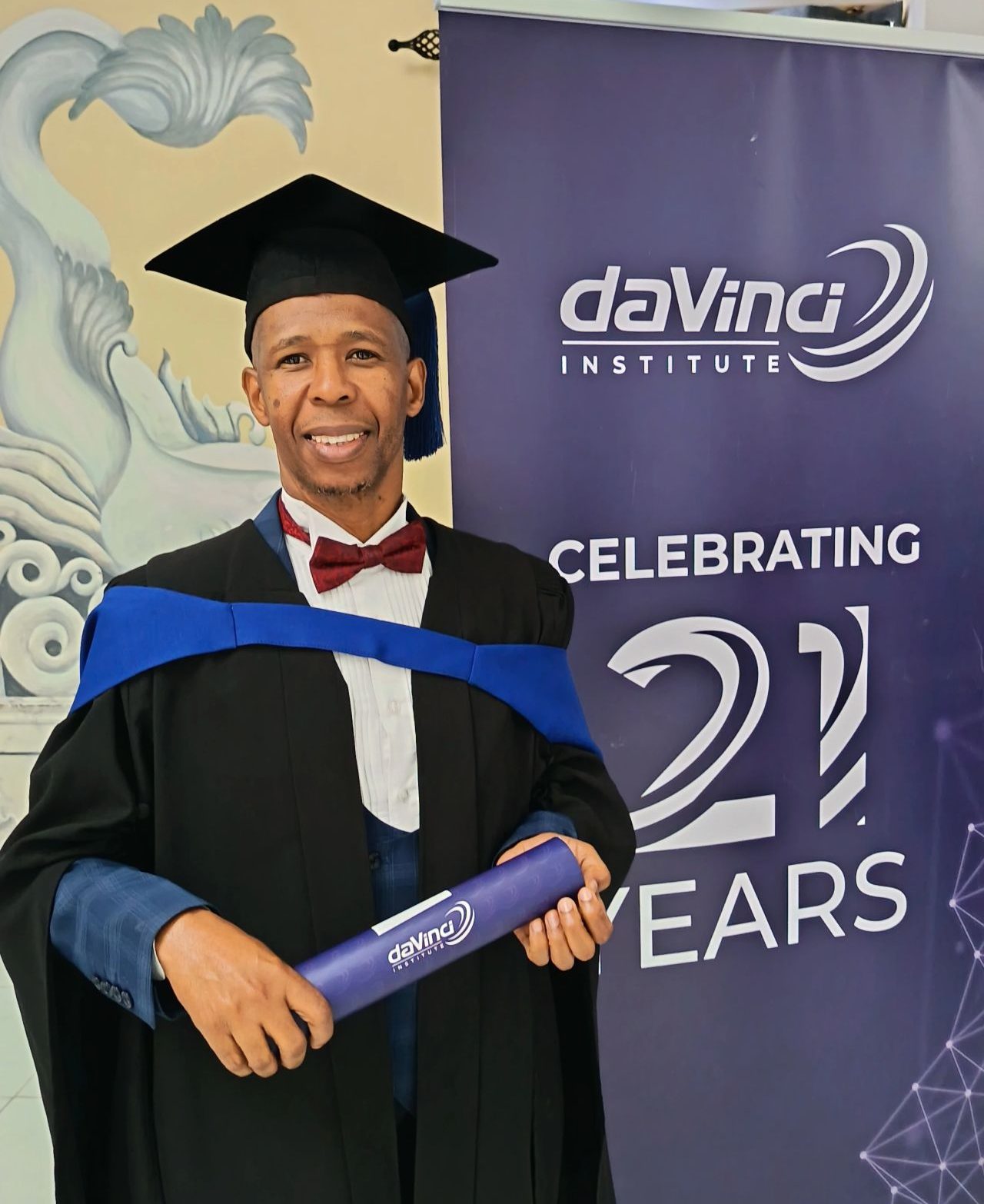
For Dr Vincent Zulu, pursuing a doctoral degree was never simply about earning a title. It was about deepening his understanding of research, technology, innovation, and their practical application in transforming education.
Today, as a leader in the science, mathematics, and technology education space, Dr Zulu serves at the Sci-Bono Discovery Centre, one of Africa’s largest science centres and a strategic partner of the Gauteng Department of Education. The organisation plays a critical role in implementing programmes in mathematics, science, coding, robotics, and technology to improve learner performance across the province.
“We implement programmes that enhance performance in mathematics and science while also introducing learners to coding, robotics and other future-focused technologies. We operate in the digital space, which is currently at the centre of the global agenda,” explains Dr Zulu.
His professional environment naturally aligned with his decision to pursue a Doctor of Technology and Innovation Management degree through The DaVinci Institute.
A Challenging but Rewarding Journey
Like many doctoral candidates, Dr Zulu quickly discovered that the doctoral journey would demand resilience, adaptability, and perseverance.
“It was not an easy journey. One of the most valuable aspects was developing an understanding of philosophy and how philosophical paradigms inform research,” he reflects.
He credits The DaVinci Institute for providing a strong foundation in research philosophy and methodology.
“DaVinci is exceptionally strong in helping students understand different philosophical paradigms. That understanding shaped my entire research journey and significantly influenced how I approached my study,” he shared.
Equally important was the support he received from those around him.
“I was fortunate to have an excellent supervisor, Professor Plondelmy Mkura, who was always available, responsive, and supportive. I also received tremendous support from my colleagues and leaders, including Professor Ntobe and Dr Mwale. Their guidance helped me stay focused and motivated throughout the process.”
Learning Through Setbacks
Despite this support, the doctoral journey was not without its frustrations. According to Dr Zulu, one of the biggest challenges was refining his research proposal.
“You often think you are on the right track, only to receive feedback that requires significant changes. At times, it feels as though you are starting from scratch,” he indicated.
However, he believes these moments ultimately strengthened both his research and his thinking.
Initially, his study was intended to focus solely on South Africa. During the proposal stage, however, a panel member challenged him to adopt a broader international perspective.
“That feedback changed everything,” he says. “It pushed me to think beyond South Africa and explore the BRICS+ context.”
The result was a comparative study examining Information and Communication Technology (ICT) utilisation in basic education across Egypt, India, and South Africa.
“That shift expanded my thinking considerably and enriched the quality of the research. Looking back, I am grateful for the challenge because it helped me produce a far stronger study.”
Research that Creates Real-World Value
Dr Zulu’s research focused on evaluating ICT utilisation in basic education within the BRICS+ context. Guided by a pragmatic philosophical paradigm and a mixed-method research approach, his work culminated in the development of an Integrated ICT Transformation Framework.
Importantly, the research did not remain theoretical.
“What excites me most is that the knowledge generated through my study is already producing results,” he explains.
One practical outcome has been the conceptualisation and implementation of a broadcasting facility within his organisation, designed to support educational access and learning opportunities for young people across Gauteng.
“As a Doctor of Technology and Innovation Management, I wanted my research to create a tangible impact. The broadcasting studio is helping us reach more learners and expand educational opportunities.”
Dr Zulu believes the framework he developed has relevance far beyond South Africa.
“The COVID-19 pandemic exposed significant weaknesses in education systems around the world. My research offers insights into how information and communication technologies can be integrated more effectively so that future disruptions do not leave learners behind.”
A Transformation in Thinking
Beyond the academic qualification itself, Dr Zulu says the doctoral journey transformed the way he thinks and works.
“The process taught me to be more organised, more disciplined, and more rigorous in my thinking,” he says.
From conducting literature reviews and applying proper referencing practices to designing coherent research frameworks, the experience fundamentally enhanced his professional capabilities.
“You learn how to construct arguments, develop knowledge systematically, and ensure that every aspect of your research aligns with your philosophical position and methodological approach,” he said.
He also believes the doctorate has strengthened his ability to engage with complex challenges and contribute meaningfully to educational transformation.
Why DaVinci Stood Out
Having previously studied through other institutions, Dr Zulu believes The Da Vinci Institute offers a distinctive approach to doctoral education.
“What impressed me most was the emphasis on understanding theories, philosophical paradigms, and the practical application of research,” he says.
“The DaVinci Institute provides a structured approach that helps students understand not only what they are researching but why they are researching it and how their work contributes to new knowledge.”
Advice for Future Doctoral Candidates
For those considering a doctoral degree, Dr Zulu offers straightforward but powerful advice.
“A doctorate is not designed to be easy. Whether you have support or not, the quality of your proposal will largely determine the success of your journey,” he says.
He believes many students underestimate the importance of investing sufficient time in developing a strong proposal.
“If your proposal is well developed, your study becomes much easier to manage. If your proposal is weak, you will face challenges throughout the process,” he says.
Dr Vincent Zulu advice to future candidates is simple:
“Focus on producing the best possible proposal. Listen carefully to feedback from your supervisor and review panels, remain open to learning, and never give up. A strong proposal is the foundation of a successful doctoral journey.”
Today, Dr Vincent Zulu stands as an example of how research, innovation, and perseverance can come together to create meaningful impact. His work continues to influence educational technology practice while contributing valuable insights into how digital transformation can strengthen learning systems across South Africa and beyond.
Leave a Reply