
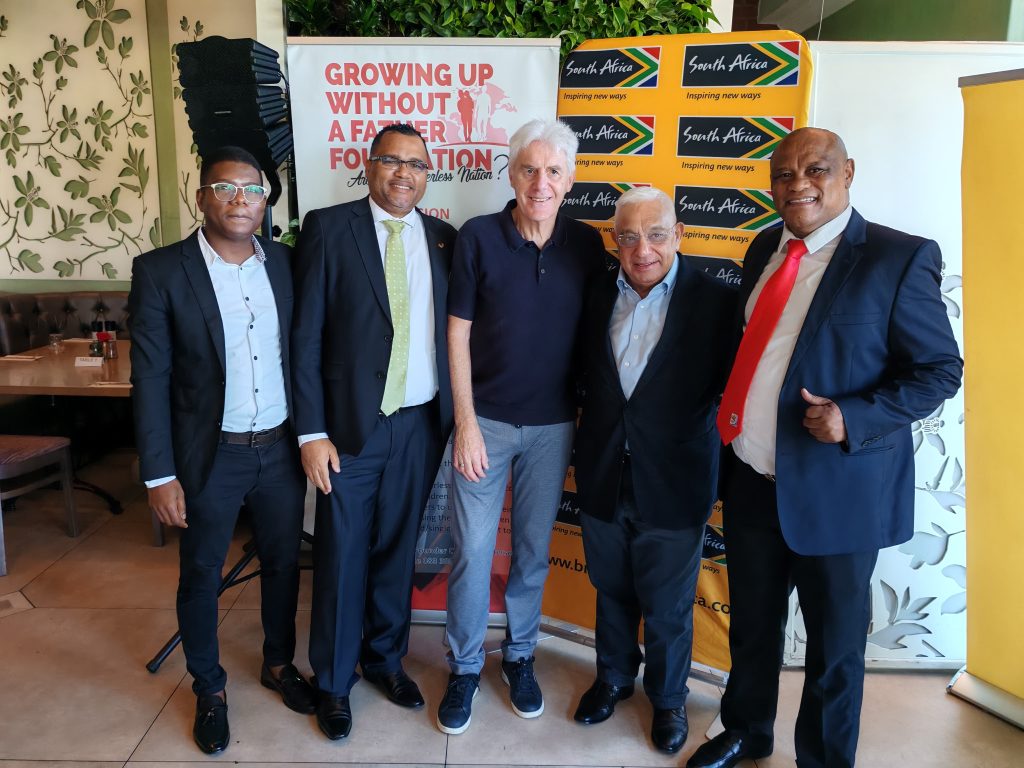
South Africa is not facing a shortage of potential. It is facing a crisis of identity. Charley Pietersen, a South African author, international speaker, and social reform advocate whose life journey reflects resilience, purpose, and transformation, recently engaged with The DaVinci Institute on the social challenges affecting men in the country.
Behind the statistics on gender-based violence, crime, substance abuse, and mental health lies a deeper and less discussed issue: fatherlessness. It is a quiet crisis, yet one that is shaping the trajectory of an entire generation of boys who are growing into men without guidance, identity, or emotional grounding.
For Pietersen, this is not theory. It is a lived experience. Born in Smithfield in the Free State and raised in a fatherless home by a single mother, he reflects the very crisis he now speaks about. From building a career in institutions like First National Bank and Standard Bank, CEO of Bloemfontein Celtic FC, Free State Provincial Office to contributing to South Africa’s 2010 FIFA World Cup success, his life has been defined by resilience, discipline, and purpose.
“This is not a theory. It is a lived experience. Growing up without a father is not just about absence. It is about unanswered questions: Who am I? Where do I come from? What does it mean to be a man?” said Pietersen.
When those questions are left unresolved, they do not disappear. They manifest in anger, bitterness, confusion, withdrawal, or destructive behaviour.
The Identity Gap No One Is Addressing
In many South African households, particularly those led by single mothers or grandparents, boys are raised with love and sacrifice. Yet love alone cannot replace identity.
Too often, conversations about absent fathers are avoided. A boy asks, and the question is dismissed. Over time, that silence becomes a gap, and that gap becomes a wound.
By the time these boys reach adolescence, the symptoms begin to show:
Emotional detachment
Aggression or rebellion
A search for belonging in the wrong places
What society often labels as problematic behaviour is, in many cases, a crisis of identity.
A One-Sided Empowerment Narrative
South Africa has, rightly, invested heavily in empowering women and the girl child. This work is necessary and important. However, it has unintentionally created a silence around the needs of boys.
“There are many platforms that say, ‘empower the girl child,’ but where are the platforms that say to young men, ‘you matter too’?” Pietersen asked.
When boys are not affirmed, guided, or mentored, they do not remain neutral. They become vulnerable to crime, gangsterism, substance abuse, and harmful expressions of masculinity.
Broken Men, Broken Systems
We cannot speak honestly about issues like gender-based violence without asking a difficult question: What is happening to our men?
It is easy to label men as perpetrators. It is harder, but more necessary, to understand the root causes behind the behaviour.
Many of the men who perpetrate violence are themselves products of absent fathers, unresolved trauma, lack of role models, and emotional neglect. This is not an excuse. It is an explanation. Without understanding it, solutions will remain superficial.
“South Africa is investing millions into addressing the symptoms of societal breakdown. But until we confront the root cause, the making of broken men, the cycle will continue,” said Pietersen.
Pain Does Not Discriminate
One of the most overlooked truths is that pain is universal. It does not matter whether you are wealthy or poor, successful or struggling or from which race or ethnicity. Emotional wounds do not recognise status.
Many men suffer in silence, believing they are alone in their struggles. In reality, across boardrooms, communities, and households, men are dealing with identity crises, mental health challenges, unprocessed trauma, and pressure to perform without support.
The difference is not the presence of pain. It is the presence, or absence, of tools to deal with it.
Rebuilding Through Purpose and Community

If fatherlessness is the root problem, then mentorship, structure, and purpose must be part of the solution. South Africa does not lack people. It lacks coordinated action.
Pietersen emphasised the importance of institutional partnerships, highlighting The DaVinci Institute as a critical collaborator in developing structured programmes for men in both corporate and community environments.
“We need spaces that do more than talk. We need spaces that equip, mentor, and transform. Through collaboration, we can begin to design programmes that address identity, purpose, and leadership among men,” he said.
Imagine a country where men mentor young boys in their communities, where skills and opportunities are shared openly, where communities take responsibility for their environments, and where knowledge flows between generations. This is not idealism. It is practical nation-building.
“Movements led by figures like Angus Buchan have already shown that when men gather with purpose, transformation is possible. The challenge is scaling that intention into sustained systems,” Pietersen added.
A Vision for the Future: The Fatherless Academy
South Africa does not lack potential; it lacks structure, guidance, and intentional spaces where brokenness can be rebuilt into strength. Across our communities, countless boys are growing up without fathers, navigating life without direction, affirmation, or a sense of belonging. What they need is not sympathy, but strategy. Not temporary relief, but lasting intervention.
The time has come for a bold and deliberate response: the establishment of a Fatherless Academy.
This Academy would be more than just a place; it would be a movement. A safe and structured environment where boys without father figures are not defined by their circumstances but reshaped by opportunity. Here, mentorship would not be occasional; it would be consistent, intentional, and life-shaping. Boys would be guided by men who understand their struggles, who have walked similar roads, and who are committed to helping them rise above their past.
Discipline would not be enforced through fear but cultivated through purpose. Values such as respect, responsibility, integrity, and self-belief would be embedded in daily life. The Academy would restore what has been missing: structure, routine, and accountability, while nurturing confidence and identity.
Every boy carries something within him: a gift, a talent, a calling. Too often, these remain undiscovered in environments of neglect. The Fatherless Academy would intentionally identify and develop these abilities, whether in the arts, in technical trades, in sport, or in leadership. Each young man would be seen, known, and developed according to his unique potential.
But development without opportunity is incomplete. The Academy would serve as a bridge between growth and real economic participation. It would connect young men to skills training, entrepreneurship pathways, and employment opportunities, ensuring they do not just dream of a better future but step into it equipped and prepared.
This is not just a vision, it is a necessity. Because when you rebuild a boy, you restore a family. When you restore a family, you strengthen a community. And when communities are strengthened, a nation begins to heal.
The Fatherless Academy is not about fixing what is broken; it is about unlocking what has always been there, waiting for the right environment to thrive.
Such an initiative would not only change individual lives but also transform communities. Pietersen believes that collaboration with institutions like The DaVinci Institute can help turn this vision into a scalable and sustainable reality.
The Work Ahead
South Africa is not beyond repair. But the solution requires honesty.
We must acknowledge the impact of fatherlessness.
We must invest in the emotional and psychological development of men.
We must create platforms for boys to discover identity and purpose.
We must rebuild communities from within.
For institutions like The DaVinci Institute, this moment calls for more than dialogue; it calls for decisive action. It is an opportunity to move beyond conversation and become active architects of change through education, leadership development, and meaningful community impact.
Because at its core, this is not merely a social challenge, it is a generational responsibility. The choices we make today will echo in the lives of young men tomorrow.
If we fail to act, we risk continuing a cycle that produces men who are disconnected, unsupported, and uncertain of their place in society. But if we intervene, intentionally, collaboratively, and with purpose, we have the power to raise a generation of men who are grounded in values, driven by purpose, and equipped to lead South Africa forward.
When men are restored, families begin to stabilise. And when families stabilise, communities grow stronger. Ultimately, it is through this restoration that a nation finds its footing again and begins the work of rebuilding itself.
Leave a Reply