Dr Jan P Bosman, PhD
In many organisations, leaders are carrying far more than their titles suggest. They work closest to the reality of the organisation, translating vision into something that actually works, while navigating pressure, uncertainty, and continuous change. Leadership is no longer driven by hierarchy or expertise alone, but by the ability to interpret context, engage meaningfully with others, and respond with awareness and intention.
In TIPS™ – The Untold Story, Dr Jan Bosman reflects on the journey through which the framework emerged, drawing on years of engagement with leaders across African organisational contexts. Rather than introducing TiPS as a model to be applied, the article traces how it took shape through lived experience, conversation, and the gradual recognition of patterns in practice.
This work unfolded across all levels of leadership, from supervisory and emerging leaders to senior and executive roles; each contributing to the patterns that would later become visible. Yet, it is often those closest to the work, translating vision into daily reality, who carry the deepest weight of this journey.
Where TIPS Comes From
The TiPS Framework did not originate in theory or academic abstraction. It emerged over time through sustained work with leaders in complex environments, particularly in mining, corporate, and institutional contexts.
A question kept returning:
Why do some leaders navigate complexity with a sense of grounding, while others struggle in the same conditions?
The difference was not knowledge or authority. It was how leaders made sense of their world and how they positioned themselves within it.
The Emergence of the Framework
In its early stages, TiPS was not a defined framework. It appeared as recurring tensions leaders were trying to resolve, often without language to describe what they were experiencing.
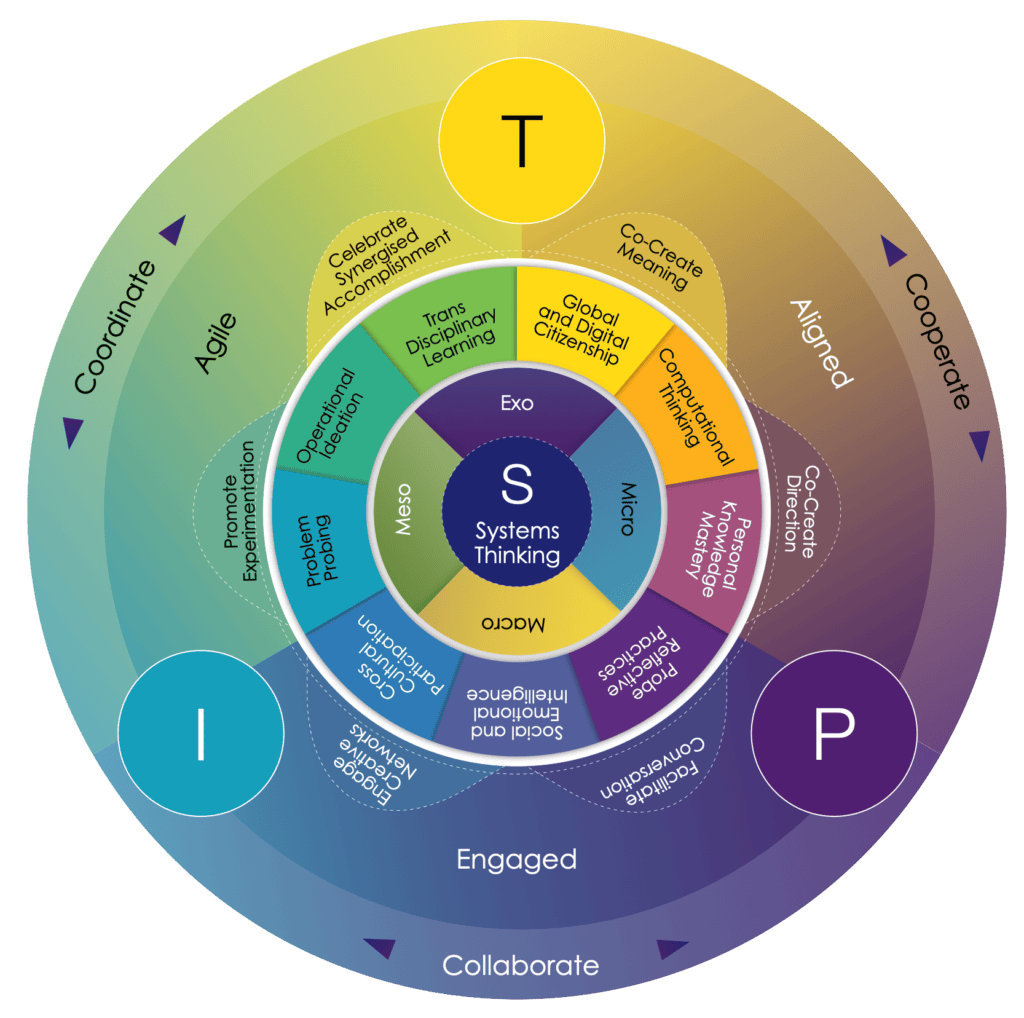
Over time, four patterns became visible:
Technology
Innovation
People
Systems Thinking
These were not introduced as theoretical constructs. They were recognised as lived realities already shaping leadership practice.
Understanding the Power of Intersections

As these patterns became clearer, their interconnections revealed deeper insights.
Where Technology and People met, alignment began to emerge.
Where People and Innovation connected, engagement became possible.
Where Innovation and Technology interacted, agility developed.
These were not designed outcomes, but reflections of what was already happening in practice. TiPS helped leaders see these dynamics more clearly and respond with intention.
A Living, Layered Framework
As the framework evolved, it unfolded into a layered architecture reflecting organisational life:
Practices – the everyday actions and conversations shaping culture
Competencies – the capabilities developed over time
Systems – the deeper structures influencing behaviour
Rather than simplifying complexity, TiPS provided a way to navigate it.
Rooted in African Wisdom
The development of TiPS is deeply grounded in African relational philosophy.
Concepts such as Ubuntu emphasise that leadership is not an individual act, but something that emerges through relationship, recognition, and shared meaning-making.
This grounding gives TiPS both contextual authenticity and broader relevance.
Leadership Development by Design
An important shift occurred as the framework became more visible.
There was a risk that TiPS could be treated as something to implement, rather than something to think with.
This led to a different approach: Leadership Development by Design.
Rather than focusing on instruction, the emphasis shifted toward creating environments where leaders could make sense of their own experience, engage in meaningful dialogue, and grow through practice.
The Emergence of Remarkable Leaders
Across contexts, a consistent pattern appeared.
Remarkable leaders were not necessarily the most qualified or visible. They were those who could remain present under pressure, build trust, and navigate complexity without losing their humanity.
In African terms, this presence is often described as seriti or isithunzi.
TiPS does not create these leaders. It helps them recognise themselves.
From Framework to Practice
The value of TiPS becomes evident when leaders begin using it to interpret their daily reality. It shifts the questions leaders ask:
Is this a people, technology, innovation, or systems dynamic?
What is happening beneath the surface?
How are these elements interacting?
At this point, TiPS is no longer a framework. It becomes a way of seeing.
A Different Way of Understanding Leadership
TiPS invites a shift in how leadership is understood.
It is not about applying a model.
It is about developing awareness.
It is not about having all the answers.
It is about asking better questions.
Leadership, in this sense, becomes a relational and systemic practice grounded in understanding rather than control.
Final Reflection
As organisations continue to navigate uncertainty and transformation, the need for grounded, relational, and systemically aware leadership becomes increasingly important.
TiPS offers not a solution, but a companion — a way for leaders to make sense of their world while remaining grounded, relational, and deeply human.

Leave a Reply